Objecting to A.I. Music
In recent months, countless commentators have speculated on the extent that Artificial Intelligence (“AI”) will decimate the white-collar workforce. Colleges graduates seeking entry level jobs now face at best an uncertain future, and more likely, a dismal one. The two questions facing society are simple to state: First, if tens of millions of jobs are eliminated, how will wealth be redistributed so that the then chronically unemployed can survive? Second, what will those millions do all day to occupy their time?
Society must now rethink work. Studs Terkel’s seminal tome, Working, is more relevant than ever. Today, a small group of Chicago musicians gathered in Federal Plaza to demonstrate against AI-generated music They are obviously concerned that AI can write and play music for a much lower cost than they can, rendering them obsolete.
Given how the companies behind AI have scraped the Internet for the material necessary to “train” the AI bots, the musicians have a legitimate gripe. It is their work that is the basis for what AI generates, but the people using AI pay no compensation for those past efforts despite the fact the prior work is protected by copyright.
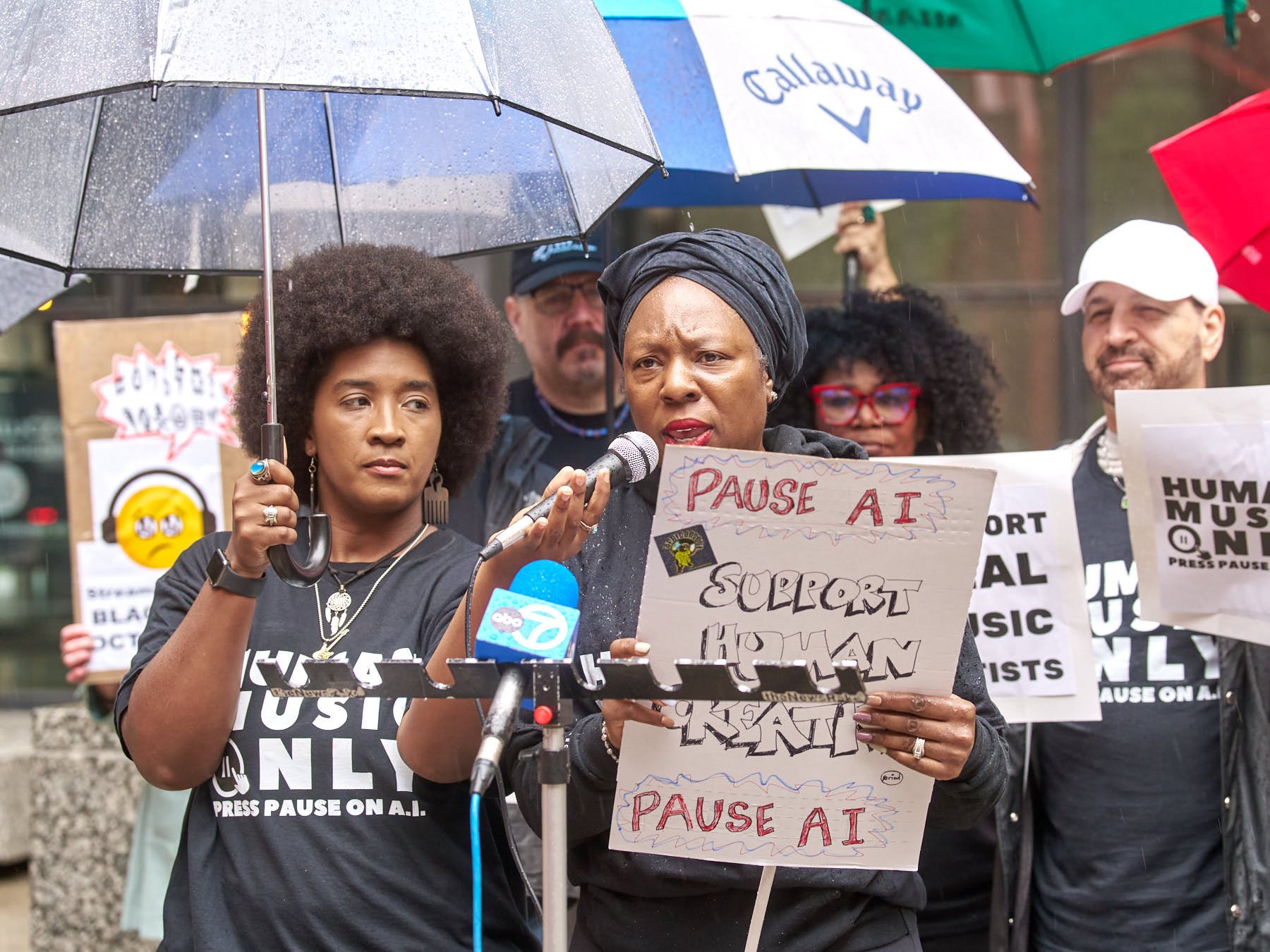
Some musicians have begun to rebel. At 1:00 PM today, I attended a demonstration in Federal Plaza that was titled “Human Music Only—Press Pause on AI” About 20 musicians gathered near Alexander Calder’s Pink Flamingo to express their concerns about AI, including Blues guitarist Melody Angel and jazz vocalist Tammy McCann.
As the drizzle fell, six or seven people spoke about the evils of AI. McCann argued that AI lacks the lived human experience necessary to create the meaningful emotional connections that can be found in the works created by thousands of musicians. McCann name-checked John Lennon, Nina Simone, and Stevie Wonder as people who understand humanity, stating:
A.I. doesn't know what it feels like to have a baby, but Stevie Wonder does. Isn't She Lovely? AI doesn't know what it feels like to dream a bigger dream for the world and for yourself, but John Lennon does. Imagine. AI doesn't know how to ask more of your country, and to ask it to live up to its better angels, but Nina Simone does. Mississippi Goddamn.
Not surprisingly, BJ Levy, the President of the Chicago Federation of Musicians (Local 10-208) took a more economic view, reminding everyone:
[that] art is labor. It takes work to create music, and I'll tell you this: somebody is making money on this music, and it's not the musicians. Okay, that means wages are being stolen. Let's be very clear about what's happening here. That is wrong, and that is why the labor movement exists. And here we are in Chicago, the home of the American labor movement.
Guitarist and singer Angel spoke of lost connections, observing:
What we have on the line is bigger than just us in our livelihood. What we have on the line is our connection to one another. Music is our connection, and if we let it go, we'll never get it back. And big tech, these billionaires want you to believe that you have no choice, that it's just the way technology is evolving.
Overall, the speakers were articulate and well-spoken. I was a bit surprised that so few Chicago-area musicians showed up. Every night, there are hundreds of musicians working in Chicago-area clubs and performance spaces. I hope that this is not the last demonstration against AI-generated music.
Unfortunately, musicians face a problem under the First Amendment. Like it or not, AI-generated music is arguably speech—at least it carries many of the attributes of speech—which may mean it is protected by the First Amendment. I suspect the musicians would counter that it is not protected speech because a human did not produce it. Responding to that argument, someone using AI to create music likely would argue that the person prompting AI is the author, with the computer being no different than a bass guitar, piano, or synthesizer. Inevitably, any attempt to regulate AI-generated music will be met with a constitutional challenge.
Musicians and composers might claim AI violates copyright laws. The question is whose copyright does an AI-generated Blues song violate—Muddy Waters’, Howlin’ Wolf’s, James Cotton’s, or Melody Angel’s? The human behind the AI song would likely rely on the “fair use” exception to copyright. Is what AI produces transformative? In the not too distant future, I suspect we will see a class-action challenge to AI-generated music. No doubt law review articles are already being written.
When I think about AI-generated music, my mind immediately goes to live performance. Will I be sitting in Carnegie Hall listening to a jazz concert with just a laptop computer at center stage connected to a bank of speakers? At that point, why go to Carnegie Hall, except to enjoy a pre-concert dinner at Trattoria Dell’Arte?
Clearly, today’s demonstration will not be the final word when it comes to AI music. Consumers rather than producers will determine whether AI music replaces musicians. In a recent New York Times article addressing AI music, readers were presented with a blindfold test between two songs—one performed by humans and the other performed by a computer. I must confess, I picked the computer-generated number.
When this group holds its next demonstration, they should make a live performance a part of the effort. To effectively make their point, they might have six musicians present at the beginning of the performance, with one musician putting down his instrument after three or four minutes, followed by the each of the other musicians putting down their instruments at successive one-minute intervals.
During the rally, people were asked to join in a nationwide October 26th and 27th boycott of the streaming platforms. Hopefully we will learn how many music consumers take part in the boycott. My bet: not a lot. Or as Joni Mitchell sang long ago:
“They paved paradise
Put up a parking lot
Don’t it always seem to go
That you don’t know what you’ve got ‘til it’s gone
They paved paradise
Put up a parking lot”
Click on an Image to Enlarge It. The Images Are Not Necessarily in Exact Chronological Order]
Demanding that AI Be Stopped In Its Tracks
Enthusiastic
Angry
Reading Her Speech
A Member of the Chicago Musicians Union Offers an Alternative to AI
Ugochi Nwaogwugwu Speaking Out Against AI Music
Jazz Vocalist Tammy McCann Making the Case for 'Real' Music
Giving a Thumbs Down to A.I. Music
A Short, But Forceful Speech From Jeannie Tanner
Speaking as Drizzle Comes from the Sky Above
Blues Guitarist Melody Angel Speaking Out Against A.I.
BJ Levy, President of the Chicago Federation of Musicians, Speaking Out Against A.I.
Concerned
Calling for a Streaming Blackout
Composer Tim Corpus Speaking Forcefully
Time for a Team Photo
Setting Down the Mic
Copyright 2026, Jack B. Siegel, All Rights Reserved. Do Not Alter, Copy, Display, Distribute, Download, Duplicate, or Reproduce Without the Prior Written Consent of the Copyright Holder.