Julia Keefe
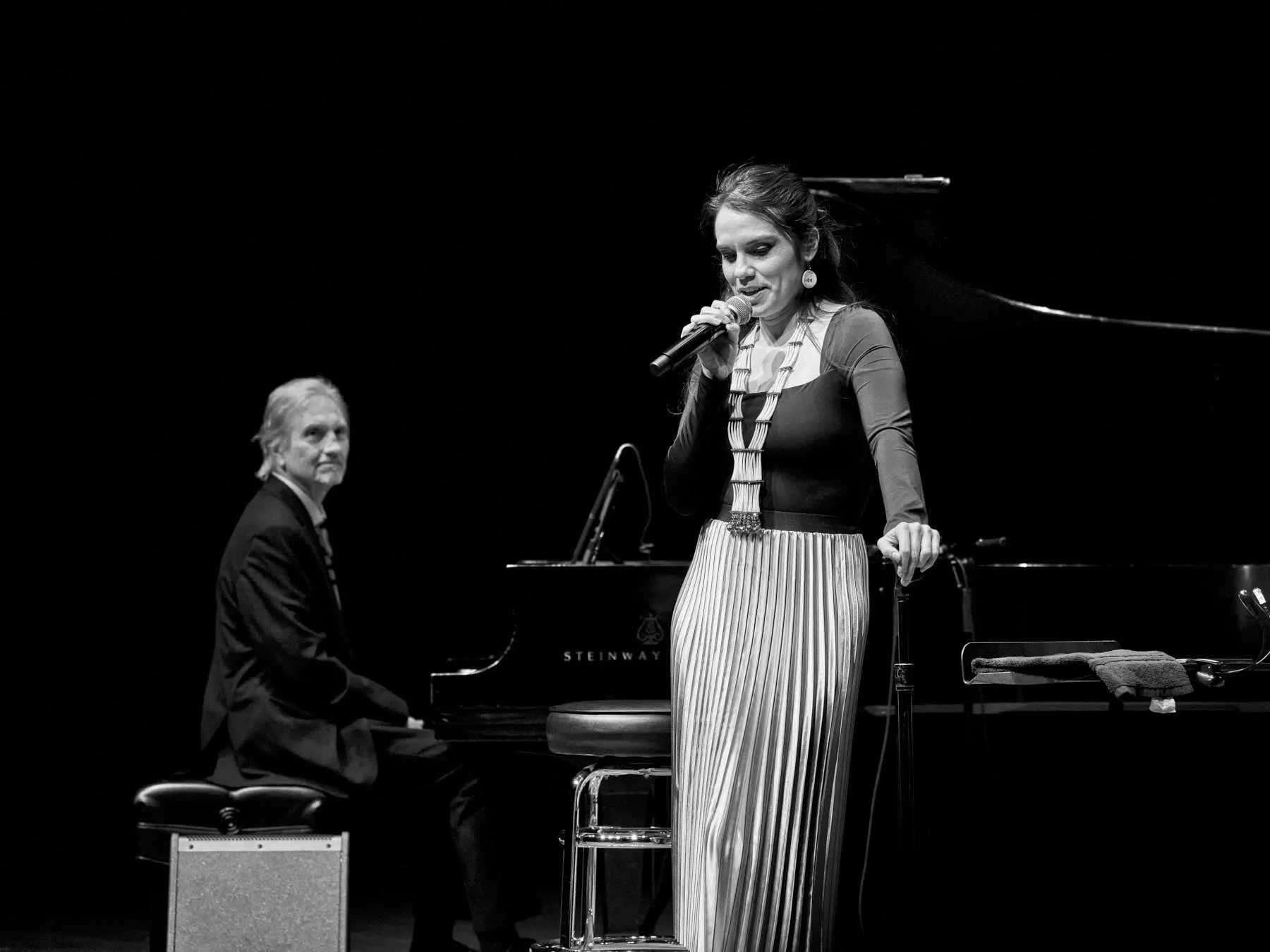
Tonight, Julia Keefe brought her Indigenous Big Band to the Reva and David Logan Center for an evening of jazz. Although the program billed the ensemble as a big band, it fell short in terms of sheer manpower. It is best described as a nonet, a pianist, percussionist, bassist, and a five-man horn section, together with Keefe adding vocals and serving as conductor. With Keef were Rogan Tinsley (alto saxophone), Adam Lamoureux (tenor saxophone), Orion White (baritone saxophone), Quin Carson (trombone), Delbert Anderson (trumpet), Marcos Varela (bass), and Ed Littlefield (drums). The pianist was uncredited in the online program.
Within mere minutes, Keefe deviated from the norm when she asked each musician to introduce themselves at the end of the first number, as opposed to making the introductions at the end of the concert. I loved the deviation because it signaled that each player was critical to what we would be hearing, rather than an afterthought. In addition to their names, each musician also identified his tribe or the reservation where he was born.
Given the reference to “Indigenous,” I entered the Logan Center wondering exactly what sort of jazz Keefe had in mind and whether visually the musicians might be dressed in “Cowboys and Indians” garb. While that possibility may seem far-fetched, the New Orleans group, The Wild Tchoupitoulas is an obvious template for colorful heritage costumes and masks while performing music rooted in the jazz idiom. In the case of The Tchoupitoulas, the masking was an act of resistance against the prohibitions imposed on Caribbeaners, Native Americans, and West Africans from practicing their respective religions.
As Keefe and company took the stage, I realized that they were the antithesis of The Tchoupitoulas aesthetic. While she and several musicians wore jewelry and other accessories that might have been purchased at a Wisconsin Dells souvenir shop—although no doubt far more authentic—each musician could have been a lawyer or an auditor reporting for work Monday morning, at least before “Business Casual Friday” became “Business Casual” five days a week. With the exception of Keefe, each was dressed in a black business suit. Keefe’s white skirt, pleated with lines of vibrant colors, may have been a nod to her Native American culture, but to my eyes, the skirt could easily have been designed by the famed Italian fashion house, Missoni.
The music was largely straight-ahead jazz, but with several “out there” numbers added to good effect. For example, while the Ed Littlefield injected colorful percussive effects on top of the rhythm, he didn’t rely heavily on what might be described as overtly Native American beats.
As I normally do, I tried to draw comparisons to other jazz orchestras as I listened. The ensemble didn’t swing like Duke Ellington’s orchestra. Nor did I hear the blues-tinged sounds that made Count Basie’s orchestra so popular. The horns certainly didn’t project the bright, brassy sounds associated with Maynard Ferguson.
While each member did solo, their efforts did not strike me as highly improvised. The visuals didn’t help on that score. Each member of the five-man horn section sat behind a black music stand, reading sheet music, as did the bass player. Both the pianist and Keefe used iPads in lieu of paper charts.
The first selection was untitled—at least I didn’t hear Keefe mention a title. Not surprisingly, it was up-tempo, with Keefe scat singing to pleasing effect.
For her second number, Keefe chose saxophonist Jim Pepper’s Water, with the horns giving the sense of wave-like motion. The song dates to the early Seventies, so not surprisingly, it had an In a Silent Way vibe to it, but given the presence of the horns, the sound was louder and more propulsive. Pepper, who played in the late Sixties with Larry Coryell and went on to work with Paul Motian, was also a Native American. He must be a Keefe favorite because the ensemble performed three of his compositions.
Next up, a selection by Mildred Bailey, who was a member of the Skitswish tribe located in Tekoa, Washington. Over the course of the evening, we heard three numbers associated with Bailey, including the encore, Hoagy Carmichael’s Rockin’ Chair. Keefe has taken on Bailey’s repertoire as an ongoing project, which explains why the orchestration was a bit bland at times. Bailey, who died from tuberculosis at 44, sang with the rather staid Paul Whiteman Orchestra from 1929-33, which is why I wasn’t hearing a lot of swing from the ensemble during the less experimental numbers.
Probably my favorite number of the evening was a three movement suite, entitled DDAT Suite. The second movement, entitled Attention, came closest to what Native American-influenced jazz might sound like. When introducing it, Keefe made reference to the Apache code talkers who were instrumental in the defeat of Adolph Hitler’s Nazi Germany. The percussive beat brought to mind images of Native Americans dancing. The suite’s extended length gave several of the musicians the opportunity to solo, leaving Paul Whiteman in the dust. Throughout the evening, I found Orion White’s work on the baritone saxophone enchanting.
Keefe injected the evening with some warranted political commentary when she introduced Blood Quantum, a freewheeling, discordant take on what she termed “genocide.” We hear lots about colonialism these days, in large part because of the war following the October 7, 2023 attack against Israel by Hamas, which once again surfaced the plight of the Palestinians. Obviously, Native Americans are no strangers to colonialist ambitions, being the first victims of American expansionism.
Keefe offered a fascinating explanation of the song’s title. According to her, someone’s status as a Native American is dependent on their percentage of Native American blood. As time passes and more and more Native Americans marry outside of the Native American community, that percentage declines. At some point, when the percentage drops below a certain level, the person is no longer considered a Native American. If enough individuals from a tribe occupying a Native American reservation no longer are considered Native Americans, the tribal lands revert to the U.S. government, effectively wiping out any signs of that tribe.
My ears perked up toward the end of the concert when Keefe announced that the band would be performing Witchi-Tai-To, which is the title to one of my go-to jazz albums, featuring saxophonist Jan Garbarek and pianist Bobo Stenson. Penned by Jim Pepper, the song has also been covered by Oregon, as well as Brewer Shipley and Pavement. Like several other selections, the entire band joined Keefe with vocalizations.
I did not like one selection—I believe it was Jim Pepper’s Pow Wow—featuring Keefe’s vocals. She made reference to peyote, which made sense given the trance-like vocalizations that almost rose to the level of repeated shrieks. For me, that was the evening’s low point.
Overall, Keefe and Company delivered an enjoyable evening of music. It is easy as a listener to be critical of any particular song, but experimentation is what jazz is all about. To the extent there were faults, they were on opposite ends of a spectrum. The orchestration for the Mildred Bailey numbers was too sedate, while Keefe’s vocals on what I believe was Pow Wow were annoyingly over dramatic.
Photographing the Concert. My experience as a photographer has taught me one thing: if it looks bad, it will photograph poorly. Take a look at the doors leading into the Hard Rock Hotel on Michigan Avenue. The metal lattice work is lovely, but the City of Chicago planted a lamppost in front of the doors. The juxtaposition does a tremendous disservice to the otherwise artful doors. I have yet to see a photograph of the doors that does them justice. The same can be said of the large clock affixed to the Jewelers’ Building on Upper Wacker Drive.
Tonight, the musicians were squeezed together on stage, with mike stands and boom attachments scattered about almost randomly. It was a mess. Obtaining even halfway decent photographs turned into a game of billiards. I had to play the angles. I was somewhat successful in my efforts to isolate individual musicians, but even then, a boom mike stand in back of the musician makes the musician look like he has been run through with a spear.
I wish stagehands would give more thought to the relationship between musicians and the equipment on stage, or allow me to position the mikes and stands. On a more positive note, many thanks to the Logan Center staff for taking my suggestion. The large white screen at the back of the stage was raised tonight, thereby creating a black background.
[Click on an Image to Enlarge It. The Images Are Not Necessarily in Exact Chronological Order]
Marcos Varela in a Moment of Contemplation
Rogan Tinsley Taking a Solo on His Alto Saxophone
Looking for Guidance from Above
Quin Carson Slip Sliding Away
The Horn Section Adding Punch
Orion White Adding Baritone Saxophone to the Mix
Julia Keefe Has Got the Chops
Plucking a Single String
Regal and Unidentified
Conducting When Not Singing
Ed Littlefield Coaxing Some Mystical Sounds Out of His Cymbals
Letting It Rip
Now Delbert Anderson on Trumpet
The Wave Representing Music
Emoting
The Dynamic Duo Playing Together
Doubling Up on Vocals
Adam Lamoureux Blowin’
Joining in the Vocals
Nonet Minus One
Looking On Admiringly
"Sonnet"
Copyright 2026, Jack B. Siegel, All Rights Reserved. Do Not Alter, Copy, Display, Distribute, Download, Duplicate, or Reproduce Without the Prior Written Consent of the Copyright Holder.