International Jazz Day
Tonight Chicago was the center of the 15th annual global celebration known as International Jazz Day. The gala staged in the Lyric Opera House and simulcast on YouTube enjoyed flawless production values and execution. Beautifully lit in reds, greens, magentas, yellows, and blues, the plunging semi-circular stage curtains brought dramatic elegance to the evening’s visual ambience.
Governor J.B. Pritzker kicked things off with a hearty welcome, giving him the opportunity to further his presidential ambitions by appearing before an international television audience. Additional speeches from Herbie Hancock, Dee Dee Bridgewater, and Khaled El-Enany, Director-General of UNESCO, alternated with the musical performances during set changes, although each was too long and anodyne.
Bridgewater read a statement from Cardinal Christophe Pierre, the Apostolic Nuncio, reporting that Pope Leo was unable to attend tonight’s celebration, but offered his papal blessings. Assuming he included the photographers in the blessing, I have now been blessed by a Pope.
Divided into bite-sized segments, the program segued seamlessly from one musical selection to another, which will ease the task assigned to the folks in charge of assembling clips for a PBS special airing next year. Although designed long before musicians plugged their instruments into amplifiers, the Opera House’s acoustics were more than up to handling the electricity. The sound was distortion-free, as if the producers had installed the Grateful Dead legendary Wall of Sound, which was built by Owsley “Bear” Stanley (who also doubled as the Dead’s chief pharmacologist).
Yet, something important was missing; that something being a jazz-filled program. With the exceptions of vocalist Dee Alexander’s self-penned number, We Got It Going On, and Melissa Aldana’s saxophone solo, I don’t think I heard an improvised note all night long (a slight exaggeration, but one rooted in reality). At times, I felt as if I was riding a moving walkway, passing one museum diorama after another — but that is not an unusual feeling when it comes to all-star gala concerts.
Many of the seats in the hall remained empty when a deep voice came over the sound system announcing that the performance would begin in five minutes. The countdown to ecstasy had begun, with the voice repeating its demand that audience members take their seats as the minutes to showtime ticked off the clock.
Whether the audience was seated or not, the program director toed the line for good reason: Lots of union workers were on-hand. Delays would have meant budget-busting overtime.
When the curtain finally rose, we were treated to the familiar opening vamp from Ramsey Lewis’ chart-topping The In Crowd. By paying tribute to the Chicago-born Lewis, who died at 86 in 2022, the organizers assured an auspicious start to the evening.
Based on the publicity surrounding the event, I had assumed that Hancock, a jazz piano icon and a member of Miles Davis’ second quintet, would function as the evening’s house pianist. Consequently, I was pleased that the producer’s chose Hancock’s 1962 “The Watermelon Man” as the second number. In a video clip, Hancock explained that the underlying piano riff represents the voices of the people living on Chicago’s South side, notifying their neighbors that the “watermelon man” was passing through cobblestone-lined alleyways with his melon-filled cart.
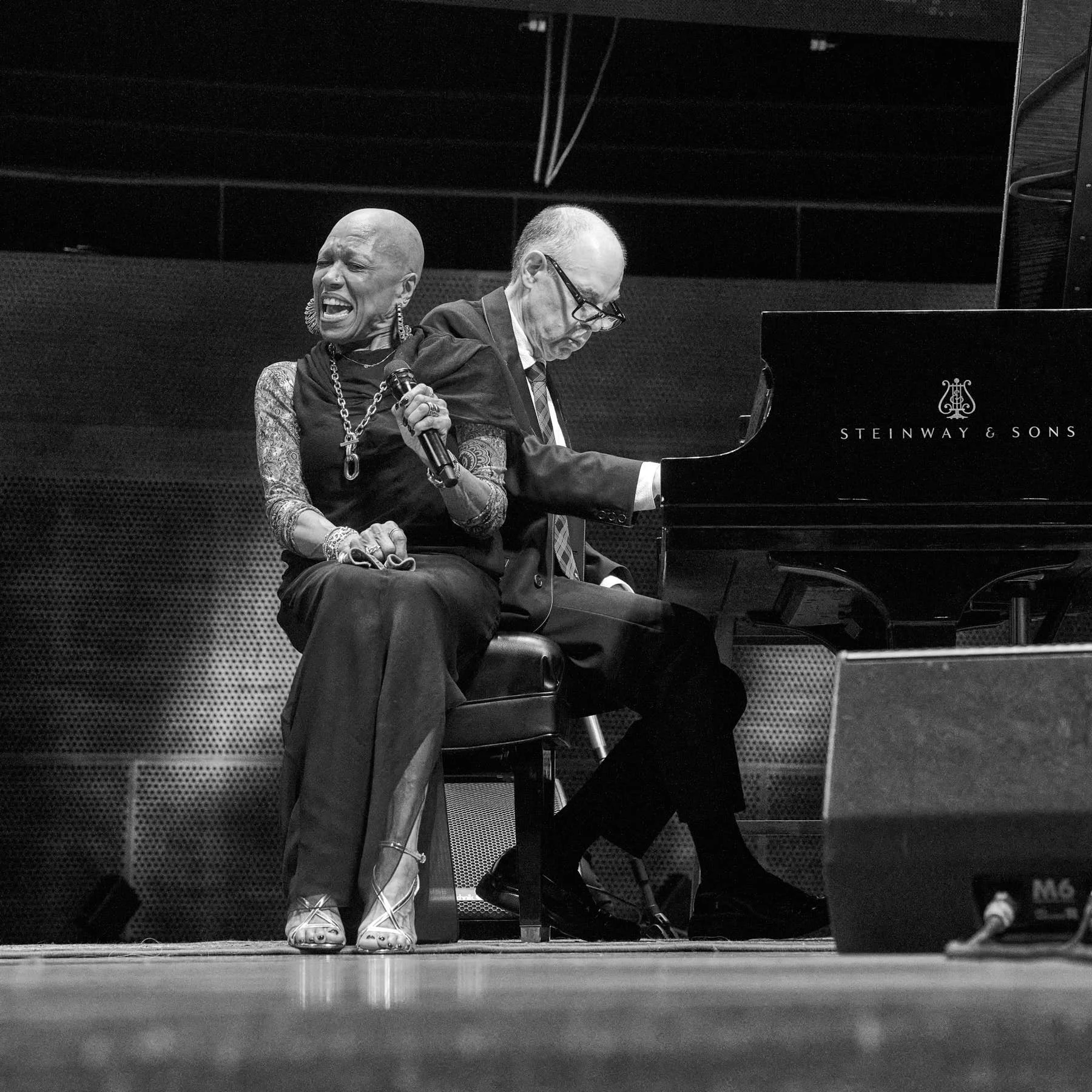
“Wow,” I thought, “this is going to be an amazing evening,” but the evening did not live up to its early promise. In general, the lineup relied too heavily on vocalists, including Dee Alexander, Jacob Collier, Bia Ferreira, Kurt Elling, Dianne Reeves, and Liz Wright. Dressed in a billowy white dress, Ferreira, sang what is best described as nondescript world music selection that simply was not jazz or anything approximating it.
Demonstrating that men can also make bold fashion statements, London-based Jacob Collier sang She’s Out of My Life, while paying homage to the late Quincy Jones, who had mentored Collier. Although Collier had an engaging voice, his feet are more in the pop than the jazz world. As a photographer, I couldn’t help but love his colorful attire. Collier also exhibited some showmanship when he did a “humming” duet with the upscale audience that had been lucky enough to snag tickets to the free concert gala. Cute, but jazz? No way!
When Reeves took the stage to perform Duke Ellington’s In a Sentimental Mood, many in the audience must have recalled that rainy night five or so years ago during Chicago Jazzfest when everyone took shelter in the Millennium Park parking garage during a downpour and tornado warnings. Although the rain eventually subsided, officials canceled Reeves’ headliner performance. As expected, Reeves delivered the goods tonight, but can any performer deliver a truly knockout performance with just one number? That was tonight’s recurring question.
Lizz Wright reprised her performance of Seems I’m Never Tired of Loving You from the 2020 International Jazz Day Concert, which, due to COVID, was a virtual concert. Tonight, Wright had the United Voices of Chicago, a 15-plus-person gospel choir backing her, making her effort stand out.
Pianist Robert Glasper offered up something approaching what would be the evening’s single solo piano performance, but it was not entirely solo. With Glasper on “two-tables and a microphone” was DJ Jahi Sundance, adding a hip-hop vibe to the evening, as well as a very subtle rhythm section. That crazy jazz lady, Judith Stein, later told me that she was enthralled with Glasper’s performance.
Early on, Buddy Guy and phenom Christone “Kingfish” Ingram gave an obligatory nod to Chicago Blues. The musicologists can better assess which came first, jazz or the blues, but neither Guy nor Kingfish should have been on the stage tonight. Nobody complained, but today is International Jazz Day. I would be hard pressed to find anyone who would characterize either Guy or Kingfish as jazz players.
One of the speakers—I believe it was Dee Dee Bridgewater—noted the road that jazz took from New Orleans to Chicago. To honor that journey, the musical curators might have had Mario Abney and the Windy City Ramblers do one of their traditional second line marches through the Lyric Opera House’s aisles as they played New Orleans-infused jazz. Or they might have called on Chicago’s Fat Babies. But neither Guy, Ingram, nor Ferreira fit the bill.
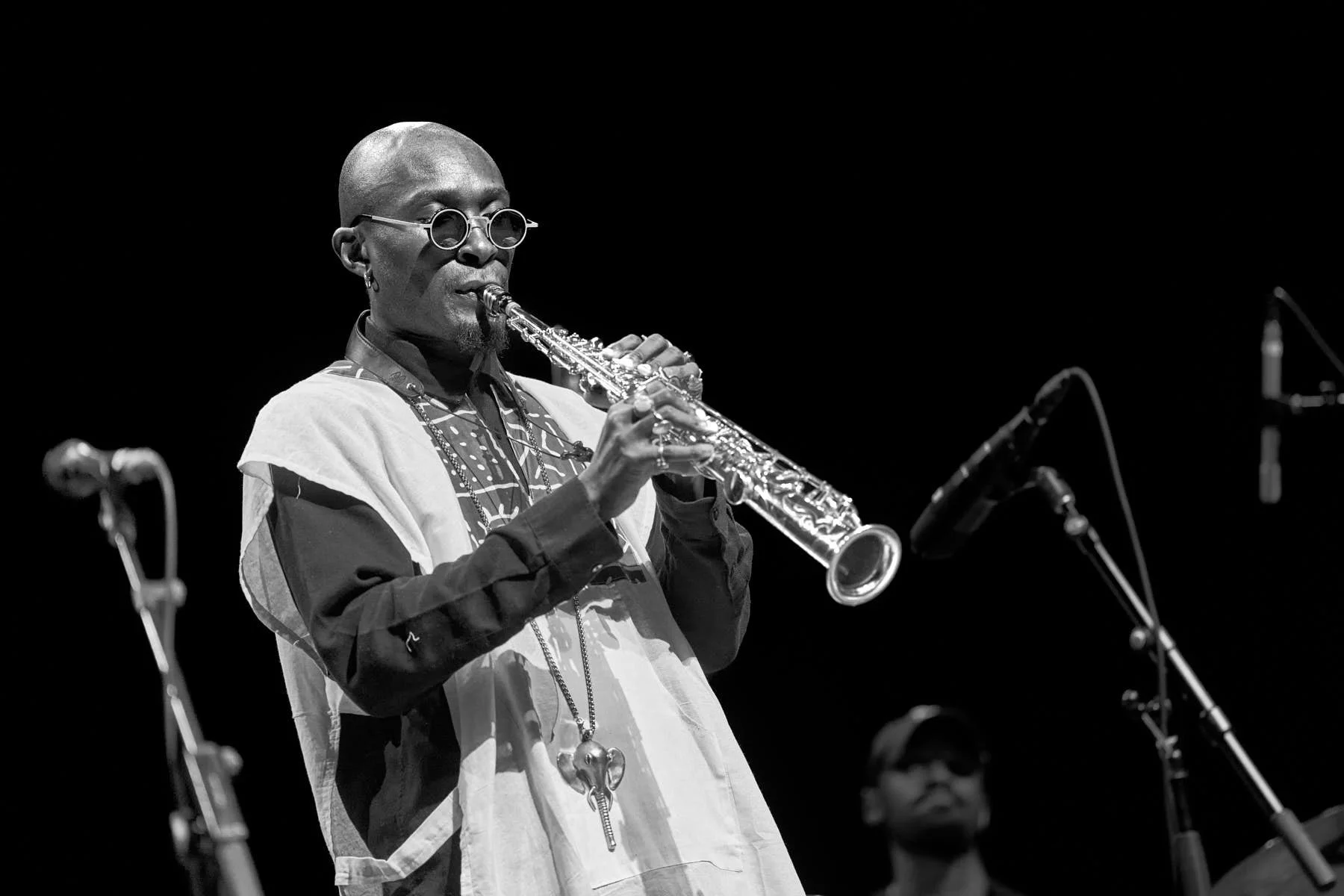
The organizers should have dropped Béla Fleck. As great an artist as he is, he is not a jazz player. Given all the great tenor saxophone players that have come out of Chicago, a classic cutting session would instead have perfectly filled out the bill. Unfortunately, Gene Ammons, Johnny Griffin, Von Freeman, and Clifford Jordan are all dead, but Mwata Bowden, Geof Bradfield, Ari Brown, Sharel Cassity, Isaiah Collier, Ernest Dawkins, Roscoe Mitchell, and Edward Wilkerson are very much alive.
For me, bassist Marcus Miller gave the evening’s standout performance. Miller was one of the countless musicians who passed through Miles Davis’ bands. With some deep funky bass lines, he reprised his composition, Tutu, from Miles’ 1986 album bearing the same title. But without Miles out front, Miller had the opportunity to truly shine, with his bass being by far the dominant instrument. He, however, was challenged a bit by trumpeter Marquis Hill.
Not surprisingly, Kurt Elling, who was Hancock’s co-artistic director, sang Dat Dere, dedicating his effort to his son, with pianist Emmet Cohen and saxophonist Ernest Dawkins making notable contributions to Elling’s effort. Elling also closed out the evening, with all the musicians and vocalists joining him on stage for what turned into a maudlin rendition of John Lennon’s Imagine. Elling kicked things off, singing an almost unrecognizable version of the Lennon’s classic, with the other performers eventually joining in. If there was ever a lead zeppelin, this was it.
I suspect that Herbie Hancock may have hand in selecting Imagine as the closer, because the lyrics echo much of what Hancock said during his speech. Whoever selected the song, he or she blundered badly. Better to end with a classic, like Lambert, Hendricks, & Ross’ Twisted, Ella, Fitzgerald’s Cry Me a River, or Count Basie and Joe Williams’ Everyday I Got the Blues.
The programmers got one thing right. Whether the international audience knew it, the program showcased many of Chicago’s highly talented players, including Bobby Broom, Ernest Dawkins, Marquis Hill, Ben LaMar Gay, Joel Ross, Henry Threadgill, and Edward Wilkerson. Unfortunately, they were often relegated as side players. While other cities who were not present at the creation might go in for world music, we have plenty of top-notch jazz players in this town. Call me provincial, but they should have dominated the concert.
I was, however, pleased to see Chicago-based Alexis Lombre at the piano. I remember her debut at the Chicago Jazz Festival when she must have been in her late teens. At the time, everyone knew that they were witnessing jazz’s future. She has lived up to those high expectations.
Also worthy of mention is Chilean saxophonist Melissa Aldana, who blew the roof off the house with a stellar saxophone solo. Others who contributed to the overall effort, at times serving as the house band, were drummer Terri Lyne Carrington, bassist Christian McBride, and saxophonist James Carter. Having marveled at Jahari Stampley’s keyboard work during a performance with Marquis Hill last Saturday night, I was also pleased that he was on hand. Noted jazz aficionado Thomas Giller was enamored by Stampley’s percussive playing.
I am probably too much of a jazzer, which is why I am a bit critical. Yet, I have to acknowledge that the evening was a lot of fun, showcasing many talented musicians. I look forward to watching the telecast of the concert sometime next year.
A Photographic Note: My photographs suck. Initially, I sat in the row reserved for photographers, which was at the back of the house. With a 400 MM lens, I was only able to capture overview shots of the stage. Typically, the maximum concert focal length is 200 MM, and the photographer is usually standing close to the stage.
Like every photographer in the “photo pit” I moved after several numbers, headed to an empty seat. Even then, the haze effects and the cluttered stage made my efforts challenging. Moreover, I was still shooting at 400 MM, which meant I was using a 5.6F slow lens rather than a 2.8F fast lens, which means more digital noise.
But at the end of the day, you do what you have to do in order to document a historic event. The organizers should have placed the photographers in the first two boxes overlooking the stage. Nobody was sitting in them. We would have been closer, with an elevated view permitting us to better deal with the speakers and mike stands.
Special thanks to Bill Michel and Kate Dumbleton for scoring tickets for me, Evelyn, and noted jazz critics Thomas Giller and Jeffrey Sosman. And an extra big thanks to jazz jack-of-all-trades, Michael Jackson, for curating a huge exhibit of work by fifteen jazz photographers (including me) , all of which (with easels) he lovingly schlepped from one venue to another during Chicago’s weeklong festivities. A place has been reserved in heaven for him.
[Click on an Image to Enlarge It. The Images Are Not Necessarily in Exact Chronological Order]
Notice of What Is Happening Inside the Lyric Opera House
Sold Out
Governor J.B. Pritzker Opens the Program with a Hearty Welcome
The Great Herbie Hancock at the Piano
Dee Dee Bridgewater, Mino Cinelu, James Carter. and Gregory Porter
Buddy Guy, Out of Place, But Still Great, As Shot from the Photographer's Pit at 400MM
Terri Lyne Carrington Keeping the Beat
"Ooh, Ooh"
Jacob Collier Conducting the Audience
The Horn Section: Tiger Okoshi, James Morrison, and James Carter
Lizz Wright Reprising Seems I’m Never Tired of Loving You
The Uniting Voices of Chicago Backing Lizz Wright
Director-General of UNESCO, Khaled El-Enamy, Offering Remarks for the All Star Global Concert
DJ Jahi Sundance Adding Hip Hop to Robert Glasper's Improvisation on Billie's Bounce
Bia Ferreira Bringing Some World Music to the Evening
Béla Fleck Joining In
Dianne Reeves In a Sentimental Mood
Emmet Cohen Playing Summertime
Bassist Christian McBride Adding Bottom While Vibist Joel Ross Looks On
Emmet Cohen Liking What He Is Playing
Kurt Elling Belting Out Dat Dere
Ernest Dawkins Showing the World How It Is Done in Chicago
Tiger Okoshi Leaning In
Dee Alexander Pauses as Ernest Dawkins Lets It Rip
Dee Alexander Has A Lot Going On, As Does Chicago
Marcus Miller Taking On His Classic for Miles Davis, Tutu, with Marquis Hill in the Background
Marquis Hill Giving the World a Lesson on How Jazz Trumpet Should Sound
Imagine Had They Not Closed Out the Concert with John Lennon's Imagine
Gregory Porter Making Sure No One Photographs His Entire Face
Together
Jacob Collier Still Smiling
Buddy Guy Shows How It’s Done
Ferreria, Wright, Bridgewater, and Porter Joining Together
Copyright 2026, Jack B. Siegel, All Rights Reserved. Do Not Alter, Copy, Display, Distribute, Download, Duplicate, or Reproduce Without the Prior Written Consent of the Copyright Holder.