Snelling Speaks
“The young man speaking in the city square
Is trying to tell somebody that he cares
Yeah, the ones that you’re calling wild
Are gonna be the leaders in a little while
”
Chicago Police Department Superintendent Larry Snelling delivered a lunchtime address to the City Club of Chicago today. Based on media reports, Snelling made no news as those attending chowed down on Italian food at Maggiano's River North banquet hall. Virtually every major media outlet that covered the luncheon focused on Snelling’s remarks regarding parental responsibility and so-called “teen trends,” or as they were called in my day, “riots.” According to Snelling,
You know, it's not parent-shaming to say that you should know where your children are at 10, 11, 12 o'clock at night, when you have a 12-year-old or a 13-year-old. They're vulnerable, you know, when they go into these environments; they can be harmed, and they can be killed, and that has happened.
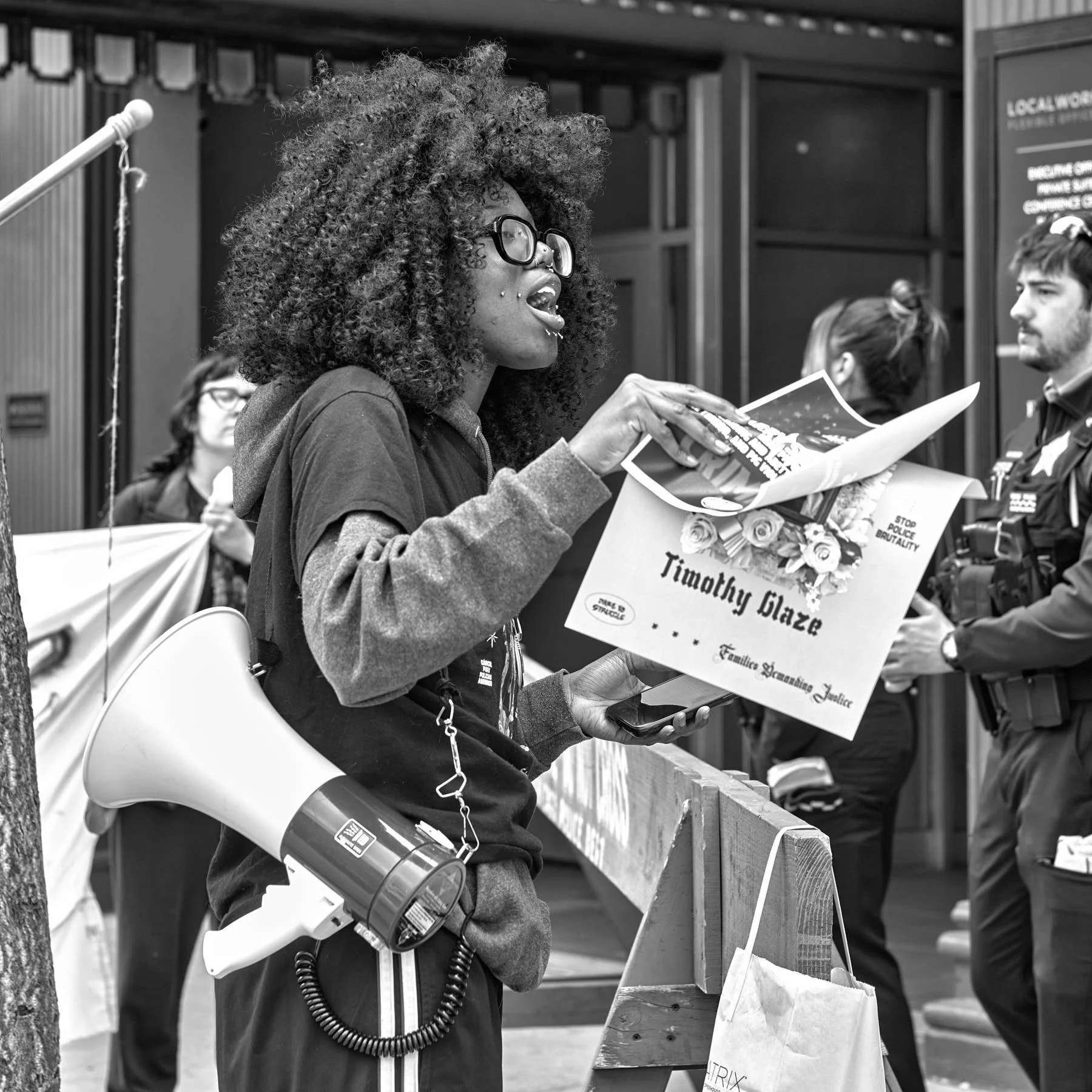
I was outside during Snelling’s talk, where five or six demonstrators stood on the street side of the faded blue police barricades, while 35 CPD officers lined the sidewalk behind those barricades. During the 45 minutes I was present, the demonstrators were peaceful, albeit a bit agitated.
Shortly after the announced starting time for the demonstration, a CPD officer informed the woman who was holding a bullhorn that CPD would enforce Chicago’s noise ordinance. I had never heard that warning issued before. I wondered whether the warning constituted a violation of the First Amendment.
Chicago City Ordinance 8-32-070 addresses noise levels. The two relevant paragraphs in the ordinance state:
(a) No person on the public way shall employ any device or instrument that creates or amplifies sound, including but not limited to any loudspeaker, bullhorn, amplifier, public address system, musical instrument, radio or device that plays recorded music, to generate any sound, for the purpose of communication or entertainment, that is louder than average conversational level at a distance of 100 feet or more, measured vertically or horizontally, from the source.
(c) The limitations imposed in this section do not apply between the hours of 8:00 A.M. and 10:00 P.M. to a person participating in: (1) a public assembly, as that term is defined in Section 108334; or (2) a parade, athletic event, or outdoor special event, as defined in Sections 108330, 108332, or 108335 of this Code; provided that a permit has been issued for the parade, athletic event or outdoor special event, if required, and the person is in compliance with the permit.
For purpose of this ordinance, a “public assembly” is defined as:
a company of persons collected together in one place on the sidewalk, or any organized march or procession of persons upon the sidewalk, which is reasonably anticipated to interfere with or impede the flow of pedestrian traffic, but will not: (i) obstruct the normal flow of vehicular traffic, or (ii) require a street closing or otherwise require police officers to stop or reroute vehicular traffic because the persons will not or cannot comply with normal and usual traffic regulations or controls.
My brief (and admittedly incomplete) review of U.S. Supreme Court precedent suggests that this statutory regime would likely survive a First Amendment challenge, assuming that is not selectively enforced on the basis of viewpoint and that it survives scrutiny as a reasonable restriction under the “time, place, and manner” standard. Representative cases include Ward v. Rock Against Racism, 491 U.S. 781 (1989); Grayned v. City of Rockford, 408 U.S. 104 (1972); and Saia v. New York, 334 U.S. 558 (1948). My observation should not be taken as legal advice or a legal opinion.
During the protest, the demonstrators cited several police shootings that they would seemingly characterize as cold-blooded murders. But rather than discussing the basis for their conclusions, the protesters engaged in what is best characterized as juvenile taunts, including:
Oink, oink piggy piggy, we’re going to make your lives shitty
The demonstrators would have been far more effective if they had outlined the facts surrounding the police shootings that they believed were unjustified. In other words, a speech or two was in order.
As for the police response. At times, I noticed a bemused look on the faces of several officers standing on the sidewalk, but otherwise, the officers ignored the taunts. Just another day at the “office.”
I did chat with a couple of officers. At one point, I noted the large number of officers, saying, “It’s like a beehive here, with the queen bee inside while the worker bees provide the queen with protection.”
Most demonstrations do have humorous moments. Today’s came when Superintendent Snelling exited Maggiano’s, so that he could acknowledge each police officer as he moved among them. He then returned inside. Whether the Superintendent intended it or not, I viewed his little excursion as a raised middle finger pointed at the demonstrators. I also laughed when I saw one demonstrator holding a pole with a donut dangling from it. No officers grabbed for it, but I did see the demonstrators pull out a box of Dunkin Donuts, which I think they may have offered to the officers.
During the protest, the demonstrators made reference to several people who had been killed in police shootings, including Darren Green Jr. Being curious, I searched for information about the incident involving Green. The Cook County State’s Attorney issued a report finding that the officer who shot Green was justified.
Put bluntly, the facts outlined in the report are harrowing. Although I have not seen the body cam footage of what transpired in the vehicle (despite trying to locate it on the web), the facts set out in the report support the use of force. While I wonder whether it was necessary for the officer involved to shoot Green in the head at close range, I was not in the automobile struggling with him as Green “shifted the vehicle into drive and stepped on the gas” with his partner “hanging onto the passenger side of the vehicle.” The report indicates that the officer in the vehicle believed his partner had been “run over or stuck under the Jeep.”
First acknowledging that I don’t have all the facts, based on what I read in the State’s attorney report, I do not see the officer’s actions as unjustified. Naturally, I do wonder whether the officer could have shot Green in the shoulder or arm, but unlike that officer, I have had plenty of time to review and reflect on the facts. I was not forced to make a split-second decision fearing for my life and the life of my partner.
Given the hundreds of shootings in the city, I have trouble being sympathetic to Green. Why was he handling a gun with an extended magazine when the officers approached the vehicle? Why did he resist arrest?
About ten years ago on a Sunday morning, I was pulled over for turning the wrong way on a one-way street. The officer asked me whether I had been drinking. “Nope” was the answer. In explaining my mistake, I pointed out that the cross streets seemed to alternate—one southbound, the next one northbound, but this street deviated from that pattern. I also noted that no cars were parked on the street, so I didn’t receive a visual cue. After he assessed the situation, he let me go without issuing a ticket. Notably, I wasn’t “handling” a gun with an extended magazine as I rolled down the window.
The protesters also seemingly operate under the assumption that police officers are quick to use their weapons. The Pew Research Center found in a 2016 survey that only 27% of police officers had ever fired their service weapon while on the job, meaning that 73% had never fired their weapons. In my experience, demonstrators don’t like it when people are stereotyped, so why are they so quick to stereotype police officers?
As for Superintendent Snelling: he seems to be doing a good job in overseeing CPD. In calendar year 2025, Chicago experienced 126 homicides, with 399 others wounded. Ten years earlier, there were 193 homicides, with another 957 people wounded. Thankfully, the trend in gun violence is downward, albeit still too high. Police-involved shootings are also down, with 22 in 2025 (eight killed) compared to 25 (11 killed) in 2016. Back in 2009, there were 61 (19 killed) police-involved shootings.
Probably the most upsetting aspect of this demonstration was the presence of a mother whose son had been killed by the police. At several demonstrations, I have encountered relatives of those who have died. Whether the person who was shot was right or wrong, I always sympathize with the relatives.
But today’s takeaway is clear: Undoubtedly police officers screw up on occasion. Regrettably, the consequences can be deadly. But before condemning the entire department, people should show a little empathy by putting themselves in the officer’s shoes.
[Click on an Image to Enlarge It. The Images Are Not Necessarily in Exact Chronological Order]
Outnumbered
"Stop Police Killings"
Capturing Images or Video of the Police Line
Looking Over at the Police Line
Maybe Not the Best Place to Park Your Corvette
Chicago Police Superintendent Larry Snelling Walks the Police Line Thanking the Officers
Facing Off
Chicago Police Superintendent Larry Snelling Escorting a Woman Into the Luncheon
Standing Watch
Remembering Timothy Glaze
Copyright 2026, Jack B. Siegel, All Rights Reserved. Do Not Alter, Copy, Display, Distribute, Download, Duplicate, or Reproduce Without the Prior Written Consent of the Copyright Holder.