Iranian Reversal, Or Is It?
“Don’t it always seem to go
That you don’t know what you got ‘til it’s gone?
They paved paradise and put up a parking lot”
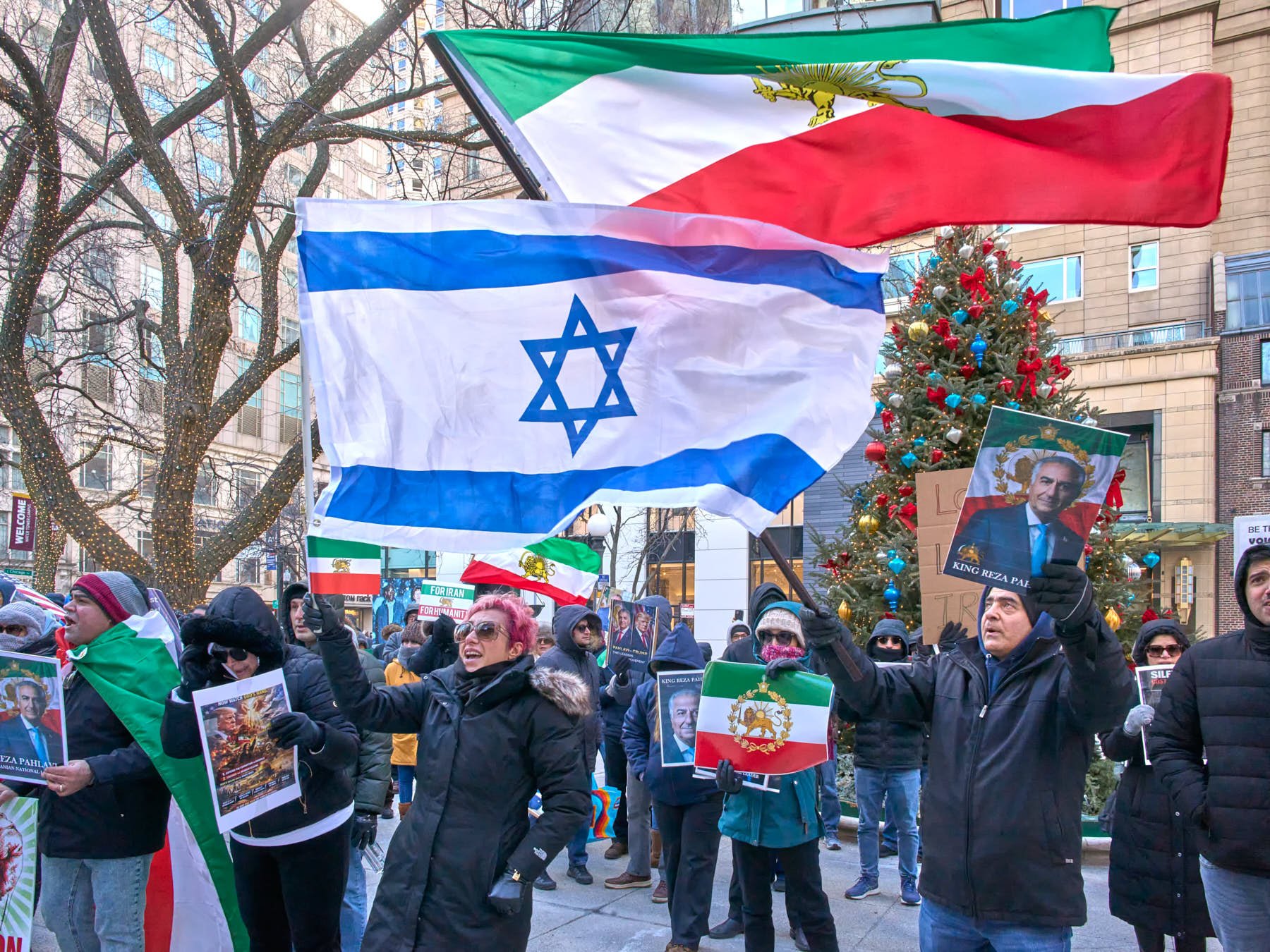
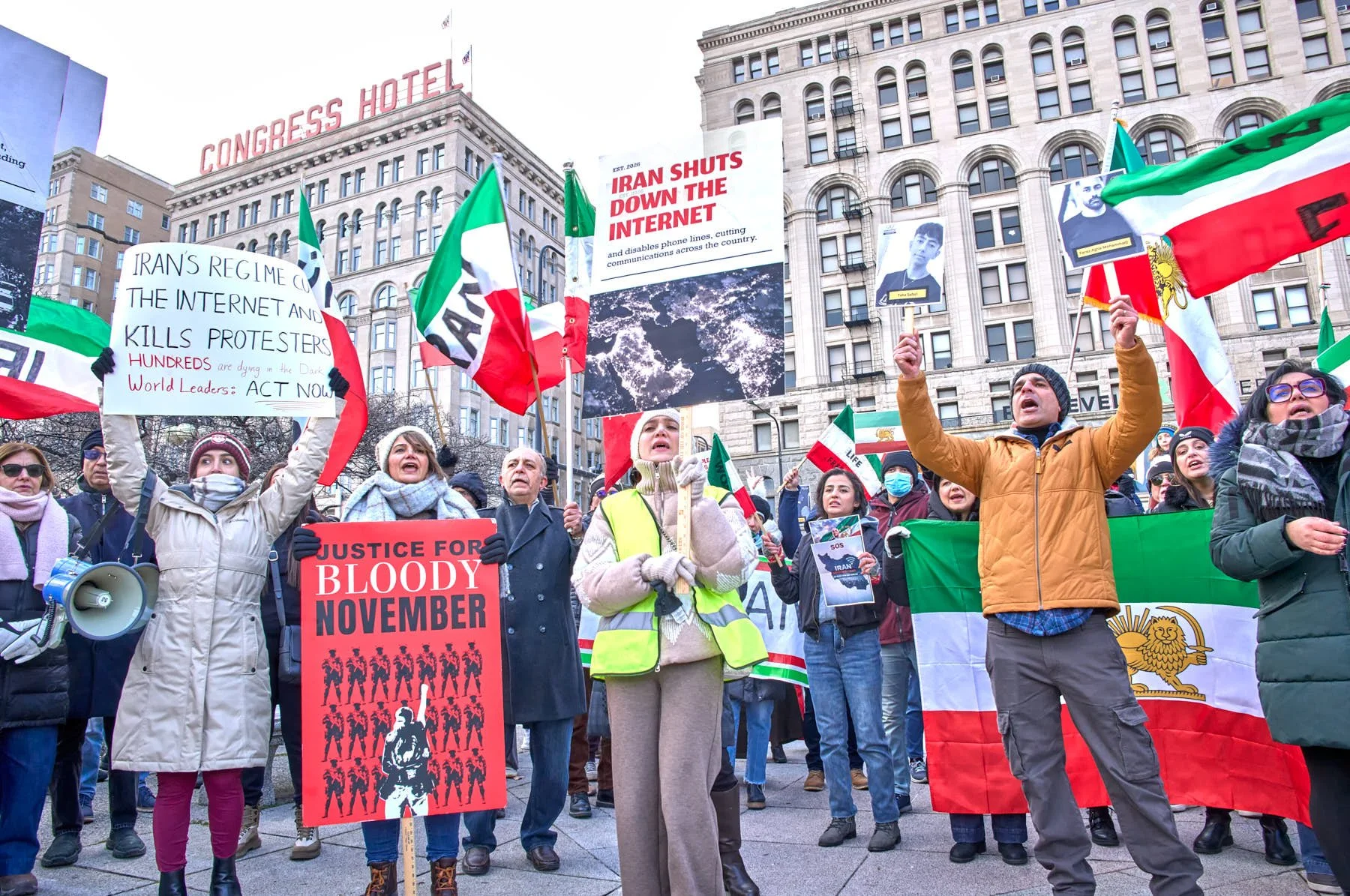
Today’s 2:00 PM demonstration in Congress Plaza near the southern tip of Grant Park produced some of the stranger imagery that I’ve encountered while covering First Amendment activity. Who would have ever thought that the American, Iranian, and Israel flags would make joint appearances at the same demonstration unless one, or possibly two of them were ablaze? Who would have ever expected signage calling for the Shah of Iran’s son to lead the country once the Iranian theocracy was deposed? A restoration of the monarchy.
Two-hundred fifty members of Chicago’s Iranian Community came together in support of their countrymen’s efforts to bring down Ayatollah Ali Khamenei’s repressive regime. On December 28 of last year, mass demonstrations broke out in multiple cities throughout Iran. The Iranian street has long been dissatisfied with the strictures imposed by the clerics on how the populace conducts itself. The latest upheaval is the largest since 2022, when Iranians took to the streets following the death of Mahsa Amini while in police custody. Amini had been arrested by the Iranian Guidance Patrol—the religious morality police—for failing to wear a hijab.
The current demonstrations were sparked by the collapse of the Iranian national currency, the rial. Since September, it has lost half of its value vis-à-vis the U.S. dollar.
The existing regime has always restricted access to the Internet, but beginning in June 2025, it imposed draconian restrictions on Internet usage. According to those leading today’s demonstration in Congress Plaza, Internet access has now been completely cut, with concomitant restrictions on phone usage. To the extent we know what is happening on the ground in Iran, we know it largely because of Elon Musk’s Starlink satellite system. In an effort to support the rial, the regime has also prohibited the use of crypto currency and gold as a means of exchange.
Before the demonstration began today, I asked one man who was toting a bullhorn what the day after the fall of the regime would look like. History has repeatedly taught that it is easier to bring down an autocratic regime than to successfully institute a democratic one.
The man told that Reza Pahlavi would replace the clerics. “Who?,” I asked. Pahlavi is the 65-year-old son of Mohammad Reza Pahlavi, the former Shah of Iran, who fled Iran on January 16, 1979 as the regime collapsed in the wake of civil strife. Pahlavi was replaced by Ruhollah Khomeini, who led the revolution against the Shah and was behind the siege of the American embassy in Tehran, which resulted in 66 Americans being taken hostage on November 4, 1979. The so-called “hostage crisis’ lasted for 444 days, effectively costing President Jimmy Carter a second term.
Given that Ayatollah Ali Khamenei replaced Ayatollah Ruhollah Khomeini following the latter’s death in 1989, Iran has been under theocratic rule for almost half a century. When the populace revolted in 1978, the Iranian people hoped to rid themselves of the Shah’s repressive regime, one that relied on torture and the gallows to maintain order. Instead, those who took to the streets replaced the Shah’s regime with what arguably became an even more repressive one. As the Internet pulled back the curtain on what consumer culture and free societies look like, young Iranians came to resent the religious zealots leading the country.
I left the demonstration puzzled: Why was the Iranian populace seeking the restoration of Shah-like rule given the 1979 Islamic Revolution? Would a monarchy prove to be a better alternative to the religious theocrats?
It turns out the man who I had spoken with was conveying only half the story. Although Reza Pahlavi claims that he will serve as a transitional leader once the clerics are removed from power, many Iranians are skeptical that Pahlavi will serve as a midwife to democracy. Older Iranians remember the Shah’s repressive regime. Yet, Pahlavi may be the only feasible option because the existing Islamic regime has imprisoned several individuals who were viable prospects to lead the country should the theocrats be deposed.
With a better understanding of Iranian politics, I now understand why I was seeing American, Iranian, Israeli flags today. Iran has never been willing to recognize the Jewish state, and the Israelis have viewed Iran’s ongoing nuclear program as an existential threat—one that could permit the Iranians to achieve their stated goal of wiping the Israel from the face of the earth. So, the old adage still holds true—The enemy (Israel) of my enemy (the Iranian clerics) is my friend.
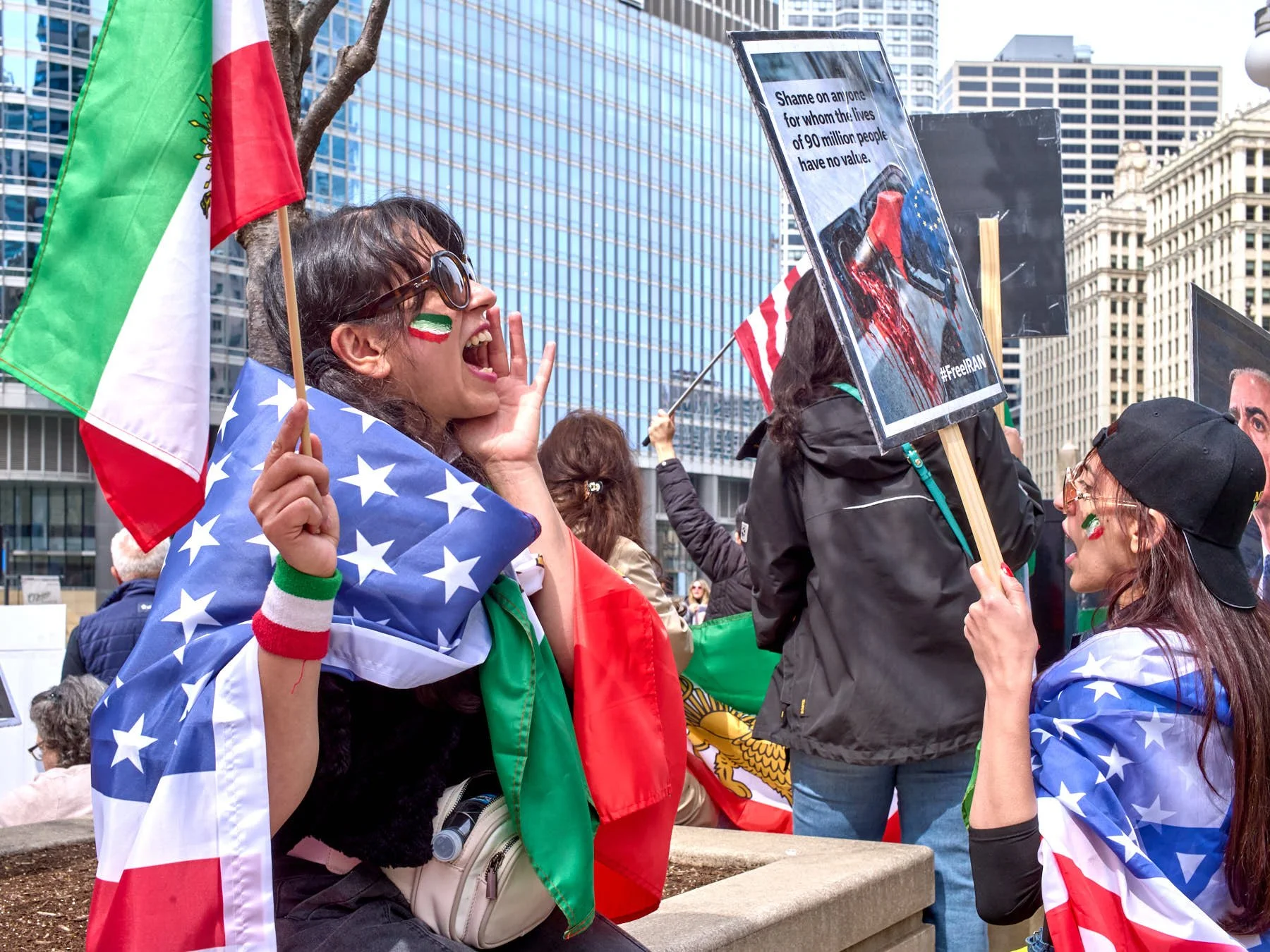
Given the U.S.’s long standing antipathy for the Iranian regime, U.S. and Israeli attacks on Iran’s nuclear facilities, and the U.S.’s unwavering support for Israel, I am no longer surprised by the American or Israeli flags that were on display today. In fact, one American flag was worn by a Persian Jew.
Moreover, when heritage group demonstrate in the U.S.—be they Chinese dissidents, Russian émigrés, Ukrainians, or others—American flags are often in the crowd. The demonstrators are signaling that they are Americans first, but harbor concerns over what is happening in their homeland because those demonstrating may have friends and family “back home,” or they hope someday to return to their ancestral lands.
I didn’t understand much of what was said during the mercifully short demonstration—it was cold, particularly because I wasn’t wearing gloves so I could better operate my cameras. Much of what was said was in Farsi, but I gathered from the crowd’s response that the speeches were enthusiastically received.
Like all rallies, the participants engaged in prolonged chanting. At times a cacophony of sounds rose from Congress Plaza and the streets. The demonstrators were not all chanting in unison. At times, I discerned simultaneous differing chants, or at least that is how I perceived what I was hearing.
Notably, several minor scuffles erupted during the rally. I heard, but didn’t see them. Two of my photography buds did see the scuffles. Possibly there were different factions from Chicago’s 10,000-member Iranian community. Maybe the scuffles were between those who support the Shah’s son and those who support someone else.
I did see several demonstrators in tears. Presumably, the speakers were recalling the blood in Iranian streets and the death count. Newspaper reports indicate that somewhere between 200 and 500 demonstrators had been killed, with thousands of others arrested. I asked one woman about the count, and was informed that there were over 2,000 casualties. [Post-Script: The U.S. Based Human Rights Activists News Agency reported that the number of dead was at least 2,000 as of January 13. The security forces have been ordered to shoot to kill].
Following the speeches, the group marched north on Michigan Avenue, remaining on the sidewalk so as not to disrupt traffic. Turning left on Randolph, the group then marched west toward Clark Street, where they turned south, headed to Federal Plaza.
When they arrived at Federal Plaza, they formed a large circle around a memorial display that was laid out in the center of the Plaza. The display included large strips of green, white, and red fabric, with Polaroid-like snapshots of Iranians who the current regime killed. Large placards recounted significant events, including the 176 passengers aboard Ukraine International Airlines Flight 752, which was shot down by the Islamic Revolutionary Guard shortly after it departed Tehran on January 8, 2020 bound for Kiev.
At 3:45 PM, the memorial ended, with everyone then heading home. As I walked toward Michigan Avenue, I encountered a man wearing a red MAGA cap and carrying an American flag. I asked him why MAGA was interested in the rally, but I did not receive a particularly informative response, which was probably due to the fact that he had others with him.
I don’t know whether the man was Iranian, but the presence of at least one MAGA acolyte does make some sense despite MAGA’s overall opposition to the sort of foreign incursions that Donald J. Trump has initiated or floated as possibilities. Trump has been urging those in the Iranian streets to continue their efforts to the overthrow the regime.
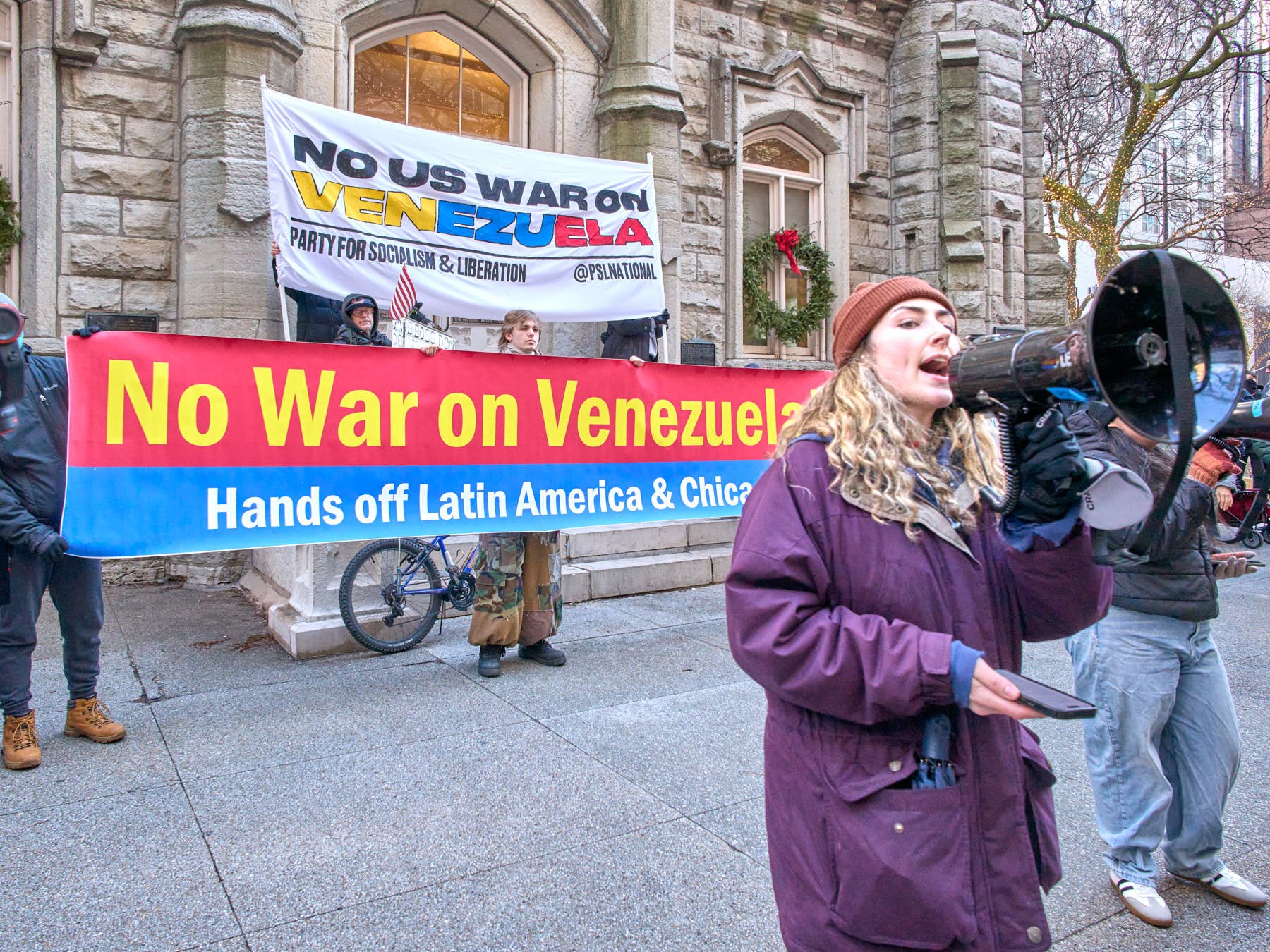
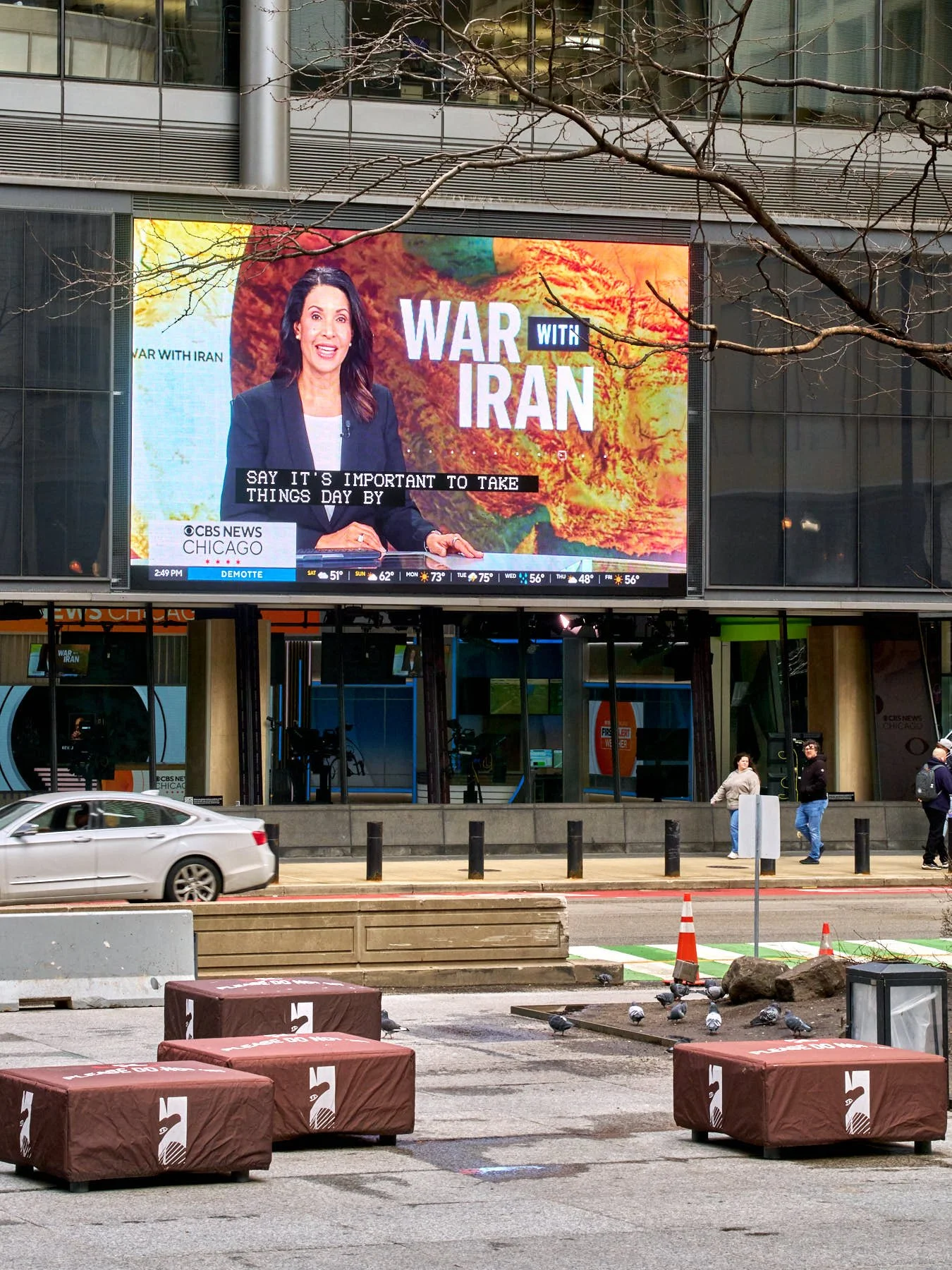
The Trump administration has simultaneously engaged in negotiations with the regime while Trump threatens military action should the regime escalate its reprisals against the demonstrators. One might legitimately ask, “Will Trump take control of the Iranian oil fields as he is attempting to do in Venezuela?”
Trump obviously doesn’t care about the people in the streets of Tehran, who have been subject to violent efforts to repress the demonstrations (like Trump is doing in Minneapolis). But additional money from oil sales going into Trump’s slush fund (rather than the U.S. Treasury) would allow Trump to further entrench himself by providing funds to tamper with the 2026 and 2028 U.S. elections.
[Click on an Image to Enlarge It. The Images Are Not Necessarily in Exact Chronological Order]
"Iran Shuts Down the Internet"
"Yes to Bread & Freedom"
Holding Images of Those Who Have Been Murdered
Calling Out the Iranian Regime
Multiple Flags
Hoping To Keep Turkey Out of Syria
Left Over From Another Demonstration
A Demonstrator Holding an Image of a Patriotic Demonstrator
Enthusiastically Waving the Iranian Flag
Calling Out the Current Regime
Memoralizing Twenty-year-Old Sajjad Valamanesh Who Was Killed By Iranian Security Forces on January 1, 2026 in the City of Lordegan During an Anti-Government Protest
Gathered In a Circle
Speaking to the Assembly
Demanding Justice for Deaths in November
Lots of Color
Speaking Out
Calling for Victory
Igor Studenkov, a Russian Émigré, Standing with Chicago’s Iranian Community
Getting Into Position for the March
Holding a Blended Flag
Wrapped in the American Flag
Showing Off the Flag for Channel 2 News
American, Iranian, and Israeli Flags Heading North on Michigan Avenue
Standing Watch
Passing the Art Institute's Lion
The Iranian Flag Billowing in the Breeze
Passing By
Up Close
“Free Iran"
Making the Turn Onto Randolph
In My Face
Marching Along Randolph Street
Closing in On Federal Plaza
In Farsi
Pointing Out the Killings in Iran
The Memorial in Federal Plaza
Displaying a Sign Showing Reza Pahlavi, the Man Who Some Demonstrators Hope Will Lead Iran
Singing in Federal Plaza
Calling for Regime Change
Calling Out the Violence
Singing During a Memorial Service for Victims of the Iranian Regime
On the Diaganol
Picturing Those Who Have Been Murdered by the Iranian Regime
Time to Clean Up, and Then Head Home
One Apparent Member of MAGA Turned Out
Copyright 2026, Jack B. Siegel, All Rights Reserved. Do Not Alter, Copy, Display, Distribute, Download, Duplicate, or Reproduce Without the Prior Written Consent of the Copyright Holder.