Mallets
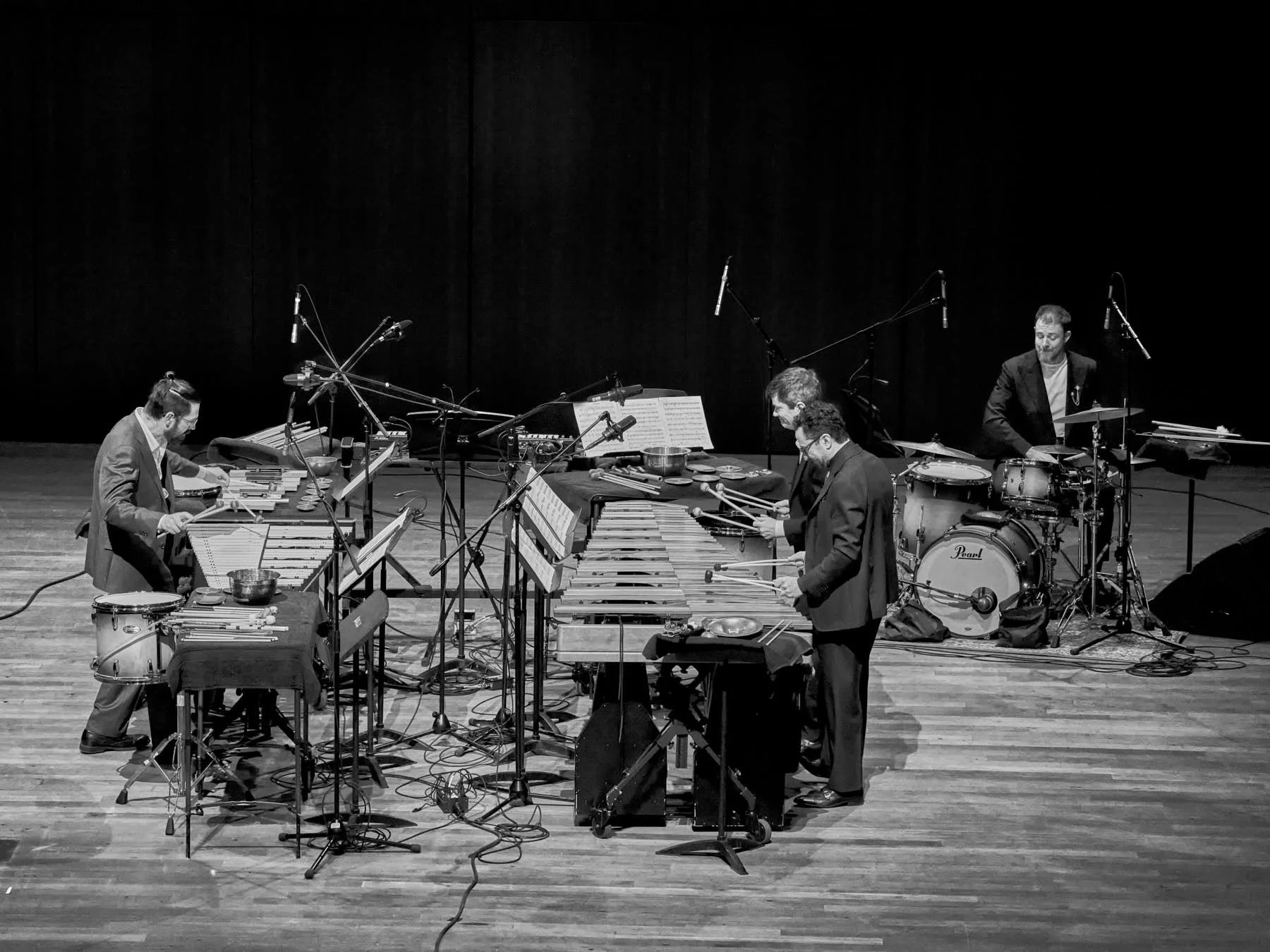
When I entered the main concert hall in the Reva and David Logan Center for the Arts tonight, I immediately thought, “This is going to be fun.” The stage was filled with instruments, including a marimba, vibraphone, glockenspiel, drums, and a piano. When the members of Grammy Award-winning Third Coast Percussion took the stage, I was genuinely excited. Along with them was Tigran Hamasyan, a pianist who would join with Third Coast for the first number—Etude No. 1—then exit the stage, returning for a solo piano recital following Third Coast’s set. The sounds that emerged were very pleasing to the ear. The marimba added a lot of warmth to the mix on what was another cold March evening. While I heard the individual notes as the percussionists struck the bars with their mallets, the marimba, vibraphone, and glockenspiel nevertheless blended seamlessly together.
Following pianist Hamasyan’s exit, the group launched into Lady Justice/Black Justice, The Song. Once again the sound arising from the bars lining the three instruments were captivating, but by the third number—Orion—I was becoming restless. The sounds grew monotonous. Yes, Third Coast varied tempo, pitch, and volume, but with the emphasis on three similar sounding instruments, the variations simply couldn’t eliminate the sense of sameness.
I have no doubt that the musicians had fun performing the music. They frequently change out mallets; sometimes they double up on the same instrument, with four mallets hitting the bars rather than two; and on occasion, they change pitch by blowing into tubes somehow connected to the instruments. Despite all their effort, I was bored even though I love minimalism of the sort practiced by Philip Glass, Steve Reich, and La Monte Young.
Throughout Third Coast’s set, I kept wondering how they could break the monotony. After thinking about it, I ruled out a saxophone or a trumpet because instruments would overshadow the sounds produced by the mallets. I finally arrived at the contrabass as the perfect complement. What I was hearing lacked bottom.
I should acknowledge that I was alone in my misgivings. The sold-out crowd ate the music up.
Following a short intermission, Armenian pianist Hamasyan sat down at the Steinway piano for a solo piano recital. Some made the obvious comparison to Keith Jarrett’s groundbreaking solo improvisational piano recitals from the mid-Seventies. While Hamasyan hummed while he played, any comparison ends there. Jarrett is more percussive than Hamasyan, who exhibited far more lyricism than Jarrett. I doubt whether much of what we heard was completely improvised. Whatever he was doing, Hamasyan’s effort was welcome relief from the earlier Third Coast monotony.
[Click on an Image to Enlarge It. The Images Are Not Necessarily in Exact Chronological Order]
Sean Connors Providing Context
David Skidmore on Drums
Robert Dillon Blowing as He Plays the Vibraphone
The Sheet Music for Lady Justice
Playing the Marimba
Peter Martin and Sean Connors Doubling Up on the Marimba
The Ensemble All in a Percussive Mood
Changing It Up with Green Mallets
Now Bowing the Vibraphone’s Bars
Introducing Red Mallets to the Mix
Focused
On Down the Line
Taking a Bow Before an Appreciative Audience
Tigran Hamasyan Surprising Himself
Hamasyan Clenching His Teeth
Plucking the Steinway’s Strings
Taking a Well Deserved Bow
Copyright 2026, Jack B. Siegel, All Rights Reserved. Do Not Alter, Copy, Display, Distribute, Download, Duplicate, or Reproduce Without the Prior Written Consent of the Copyright Holder.