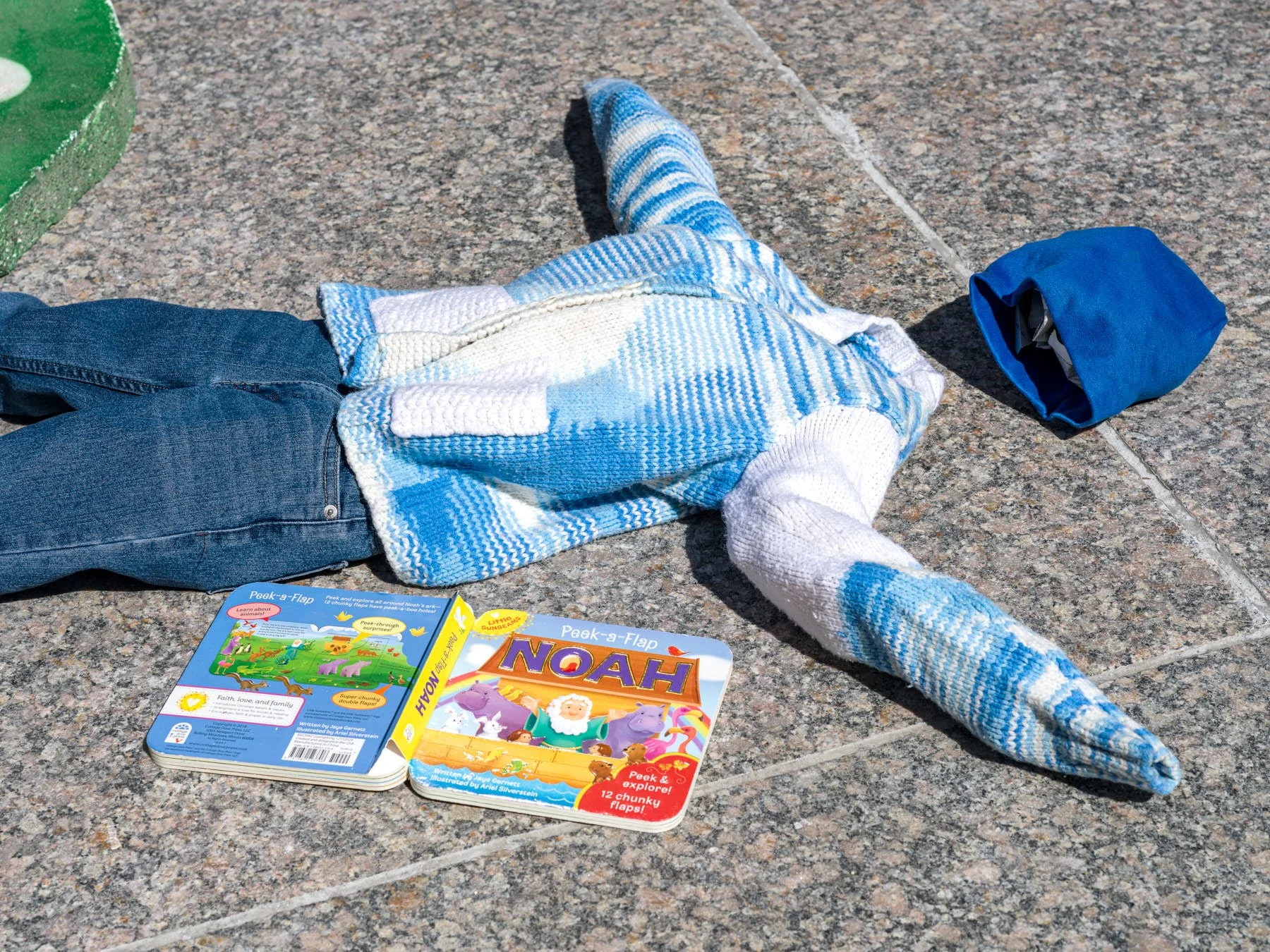
Canceled
Growing up in the Midwest, I was aware of the occasional disputes between organized labor and large industries. When the United Auto Workers or the United Steel Workers threatened to strike, the story often led the CBS Evening News with Walter Cronkite. With air travel still an expensive luxury, I was far less familiar with Cesar Chavez’s efforts to organize California farmworkers.
California was far, far away. A couple of lucky kids had made the trek along Route 66 to Los Angeles in the backseat of the family sedan while playing “Punch Buggy” with their siblings, as their parents begged for peace and quiet. I had no idea that many of the fruit and vegetables I regularly ate came from California. What I knew of California came from idyllic sounds produced by the Association, the Beach Boys, the Byrds, Jan & Dean, and the Mamas and Papas.
Despite my childhood ignorance, Cesar Chavez was a big deal. J. Edgar Hoover believed Chavez warranted an FBI investigation because Chavez was a labor organizer and a Christian Leftist. He had founded the National Farm Workers Association in the Sixties, which through a merger, later became the United Farm Workers labor union (“UFW”). Influenced by the likes of Mahatma Gandhi, Emiliano Zapata, Eugene V. Debs, and Saul Alinsky, Chavez and his movement rose to national prominence, with his organizing efforts eventually spreading beyond California.
As a labor leader, Chavez was instrumental in organizing strikes by grape and lettuce pickers, among others. His influence did not stop in the farm fields. He spoke out against the Vietnam War, helped lead the civil rights movement, and participated in major rallies and marches. Surprisingly, he was a forerunner to Donald J. Trump, campaigning against what are now referred to as undocumented immigrants. It wasn’t that the migrants were Brown, but rather that they were used by management as strikebreakers.
Chavez died in 1993 at age 66. Over 50,000 people attended his funeral. A year later, President Bill Clinton posthumously awarded him the Presidential Medal of Freedom. In 2006, Republican Governor Arnold Schwarzenegger inducted Chavez into the California Hall of Fame. In 2012, President Barack Obama designated the Cesar E. Chavez National Monument in Keene County, California.
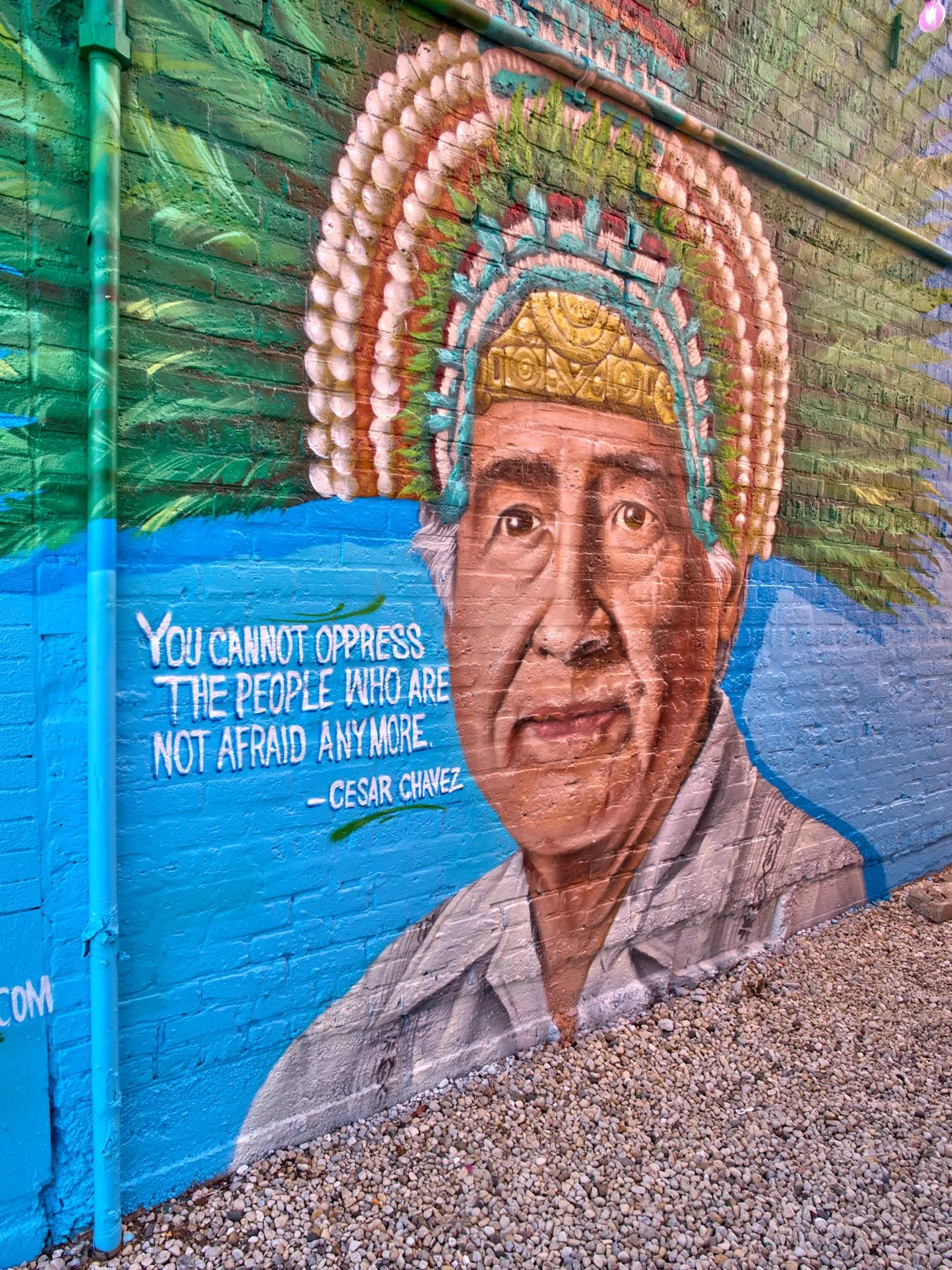
The UFW created the National Chavez Center. Several states declared Chavez’s birthday a state holiday. His face adorns murals throughout the country. Stevie Wonder even made reference to him in Black Man, which appears on Wonder’s 1976 album, Songs in the Key of Life.
Just two days ago, on March 18, everything changed. Chavez’s reputation was destroyed when the New York Times published an article revealing that Chavez had allegedly sexually abused two underaged girls on a regular basis between 1972 and 1977. What is amazing is how quickly the world canceled Chavez.
Plans have already been announced to rename schools, parks, and roads that now carry Chavez’s name. Officials have announced that designated state holidays in Chavez’s honor will be canceled through corrective legislation. Murals depicting Chevez already have been “whitewashed.” Statues have been removed.
I was curious whether the mural near my house had been painted over, so I took a walk late Friday afternoon to check it out. As my photographs reveal, it still adorns the north wall of Cafe Tola near the intersection of Addison and Southport. I was not surprised that the building’s owner had not yet removed the mural given how recent the revelations about Chavez’s conduct were, but I was surprised that nobody had yet added graffiti condemning Chavez. I will check back in a week to see whether the mural has been covered over.
From Chavez’s standpoint, the revelations come at a most inopportune time. Jeffrey Epstein’s saga has given the country plenty of opportunity to ponder pedophilia, so it is not surprising that the public response to the Chavez revelations was so quick. The Epstein story had been a slow burn for several years until it gained widespread public attention, catapulting the scandalous acts into the public’s consciousness. The public will no longer tolerate a grace period when pedophilia is revealed.
Commendably, Democratic politicians appear to be the ones who cleaned house, taking down the once sainted Chevez. Republicans have not been nearly as quick to hold Epstein’s johns to account. In particular, they have closed their eyes when it comes to Donald J. Trump despite repeated references to Trump in the Epstein files, with one victim making particularly tawdry allegations against Trump.
During his lifetime, Chavez certainly did a lot of good, which raises an interesting question: What transgressions and how large must they be to result in instantaneous cancellation? To be clear, I certainly don’t condone Chavez’s alleged behavior, but I also recognize that all of us are flawed. Do and should our flaws completely overshadow the good that we have done?
Because it involves children, pedophile is a black and white line not to be crossed—there is no grey area. The violator’s good deeds instantly vaporize, carrying no offsetting weight.
Nevertheless, it will be interesting to see whether Chavez will be totally erased from the history books, or whether in 25 years, his pedophilia will be a significant, but not the only chapter in Chavez’s larger story.
Mural Depicting Cesar Chavez (March 20, 2026) at 3612 North Southport Avenue, Chicago, Illinois 60613
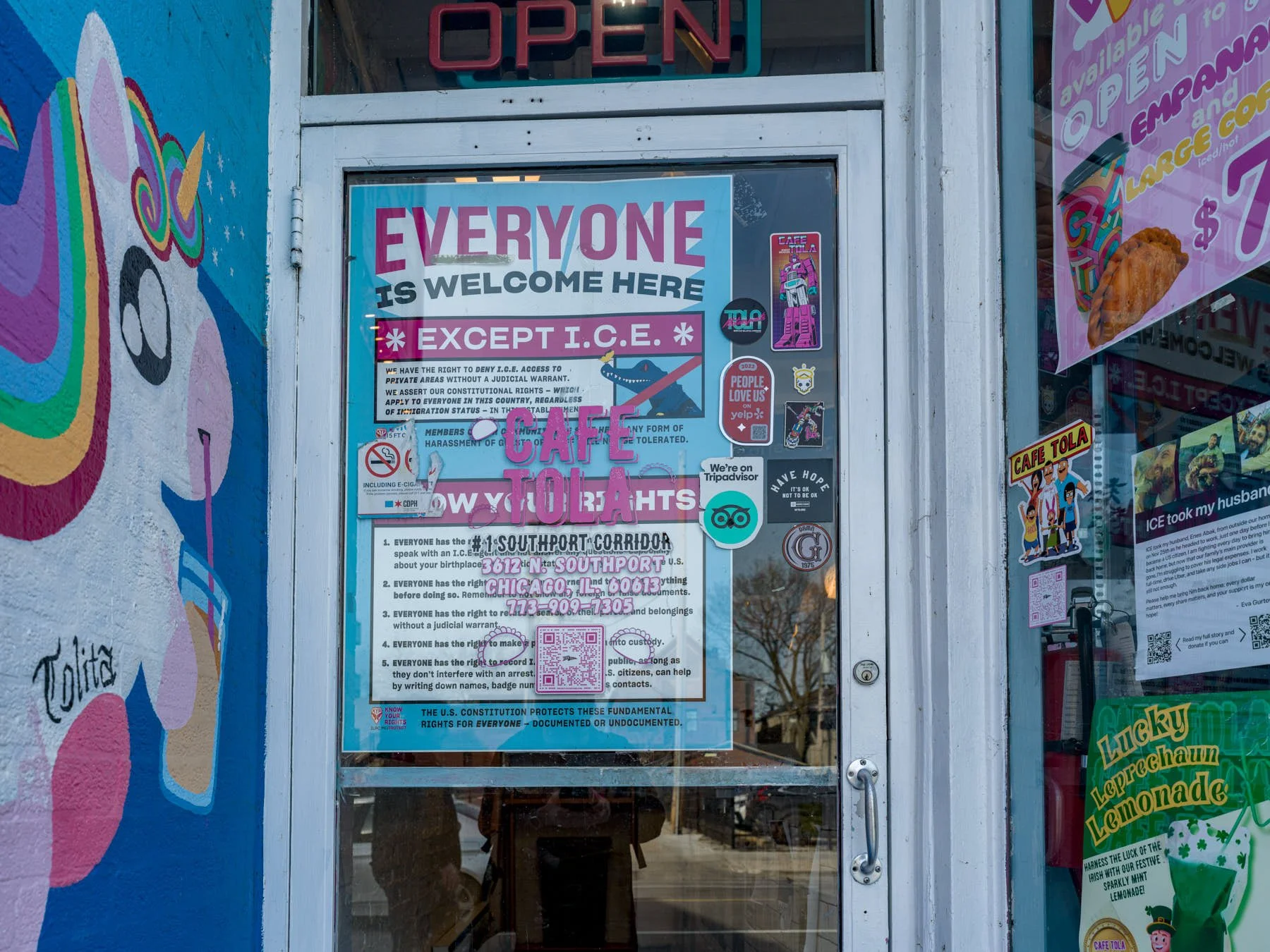
Cafe Tola Making It Known that Immigration and Customs Enforcement Officials are Not Welcome on Its Premises
Copyright 2026, Jack B. Siegel, All Rights Reserved. Do Not Alter, Copy, Display, Distribute, Download, Duplicate, or Reproduce Without the Prior Written Consent of the Copyright Holder.