Isaiah Collier
The 15th Annual International Day Jazz Gala Concert turned into a week-long affair. Last Saturday night, I attended a performance by trumpeter Marquis Hill at Northwestern University. Monday, I was at the Logan Center for Orbert Davis and the Chicago Jazz Philharmonic’s take on Miles Davis’ Sketches of Spain. Tuesday, I was back at the Logan Center for sax man Geof Bradfield’s evening concert. Earlier in the day, I was in class at the Gleacher Center for my Spring class covering Russian author Nikolai Gogol and his contemporaries. Dead Souls was the reading for the day.
Wednesday afternoon I attended a panel discussion at the Chicago Cultural Center featuring Herbie Hancock, Marcus Miller, and Kris Bowers. Last night, I was at the Lyric Opera House for the International Jazz Day concert. This morning, I got up, and headed to Union Park for the annual International May Day Workers’ march, which saw me putting seven miles on my odometer.
As I was walking from Union Park to Daley Plaza with 2,000 demonstrators, I gave serious consideration to skipping Isaiah Collier’s tribute to John Coltrane at the Logan center tonight. I was exhausted, particularly because somewhere along the line, I managed to work in two doctors’ appointments, process photographs, and write three posts.
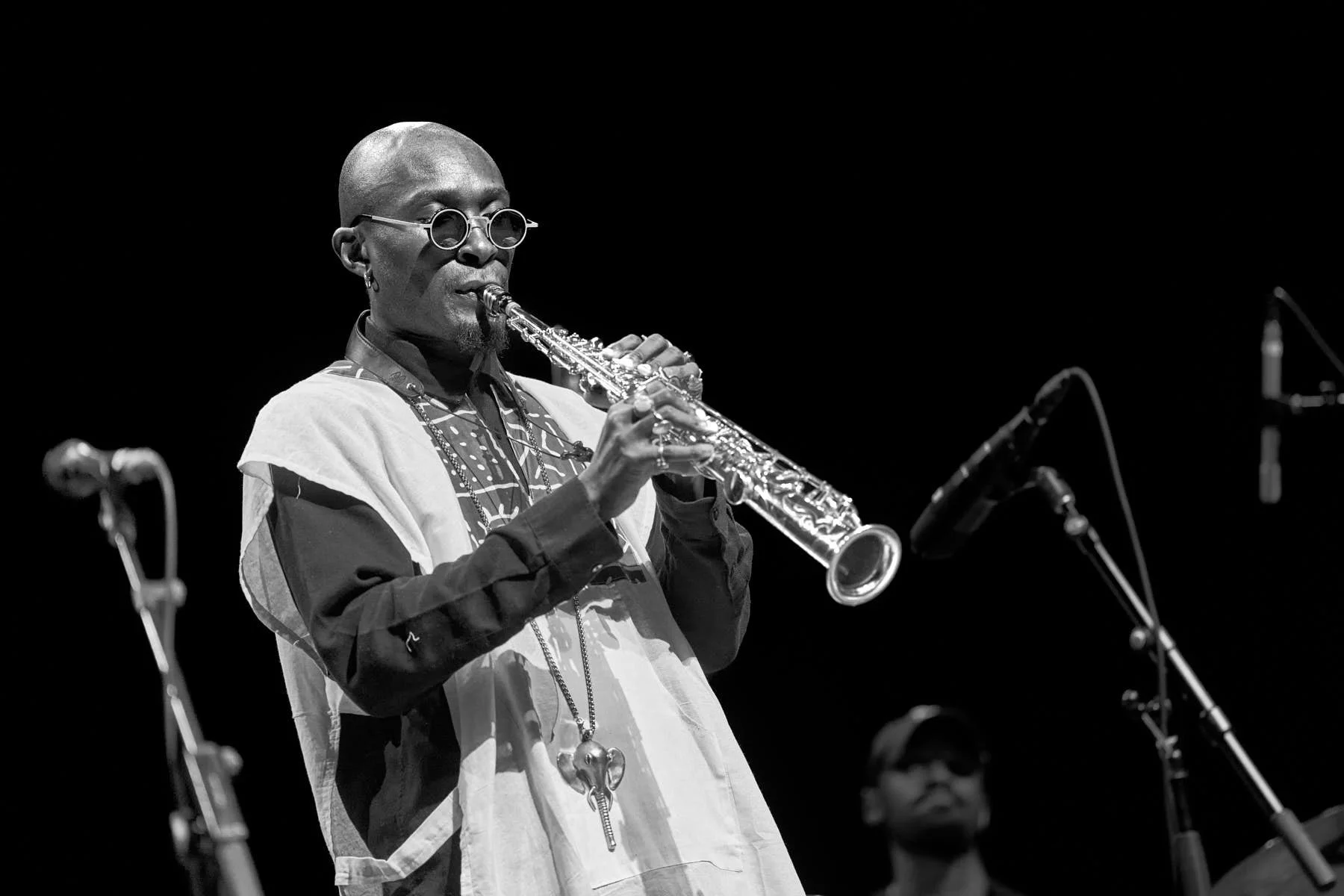
Yet, I gutted it out, reaping rewards for my effort. Saxophone phenom Isaiah Collier was closing out International Jazz Day week at the Logan Center with a tribute to the late John Coltrane. With Collier were bassist Joshua Ramos, drummer Tim Regis, and pianist Davis Whitfield. For the last three numbers, veteran saxophonist and AACM member Ernest Dawkins joined what had been a quartet.
During the 90-minute concert, Collier and company reached back into Coltrane’s oeuvre, pulling out Chasin’ the Bird, Lonnie’s Lament, Mr. P.C., My Favorite Things, and Naima, among one or two others. Collier exhibited the intense and flashy playing that has catapulted him into the international spotlight over the last decade. Whether Collier was playing the tenor or the soprano saxophone, sheet after sheet of notes came flying out of his saxophone.
In a 2025 interview for Downbeat Magazine, jazz journalist and photographer Michael Jackson asked Collier about his circular breathing technique, which allows Collier to keep blowing indefinitely. An excellent question, because throughout Collier’s entire set, I kept wondering to myself, “When does this guy come up for air?” Collier first learned the technique when someone told him, “Get a straw, and a glass of water, keep blowing and keep the bubbles going.” Collier must have blown a lot of bubbles because he certainly mastered the technique.
While Collier is clearly impressive, in my view, he needs to learn two lessons. First, although this concert was a tribute to Coltrane, I would have appreciated Collier allowing his bandmates to take more solos, with a duet or two thrown in for good measure.
Second, Collier needs to learn the lesson that many of his famous elders took to heart throughout their long and productive careers: It is not what you say, but what you don’t say that often has the greatest impact. While the Coltrane “sheets” are great, Collier should also be listening to Sonny Rollins, who is admired for the empty spaces he left between the notes.
In all candor, I was and am always impressed by Collier’s technique, but tonight I grew a little bored with the set. Too much of the same thing. To some extent, that can be excused given the focus on a single musician. But had I been Collier, I would have gone deeper in Coltrane’s catalogue. For example, he might have opted for Blues to Elvin, from the 1962 album, Coltrane Plays the Blues. In addition to being more meandering and circumspect, Blues for Elvin would have given Collier’s sidemen an opportunity to display their skills through different combinations of solos and duets.
Collier did offer up one surprise. For the last third of the set, elder Ernest Dawkins joined Collier, bringing an alto and soprano saxophone with him. I enjoyed the friendly battle that took place between the two saxophonists. To Dawkins’ credit, he did not attempt to upstage his host, but that comes as no surprise. Dawkins is a gentleman.
Despite my reservations and criticisms, Collier and Company served up an enjoyable evening of jazz.
[Click on an Image to Enlarge It. The Images Are Not Necessarily in Exact Chronological Order]
The Soprano Sax Comes Out
Altogether Now
Smiling While Keeping the Beat
Ernest Dawkins Making a Surprise Appearance
Isaiah Collier Playing My Favorite Things
Joshua Ramos on Bass
Davis Whitfield Diving for Notes
Isaiah Collier Identifying The Songs
Adding Some Chimes to the Mix
Davis Whitfield Up Close
A Single Finger on the Strings
Tim Regis Behind the Mics
He Has a Firm Grip on the Music
Going in For the Handshake and Hug
Ernest Dawkins, Joshua Ramos, and Isaiah Collier Working Things Out
Raising His Tenor Up
The Tats Come Out
Ernest Dawkins on the Attack
Big Bossman Brings Out the Tenor
Workin’ Together
Joshua Ramos Positioning His Lefthand
Head On
Copyright 2026, Jack B. Siegel, All Rights Reserved. Do Not Alter, Copy, Display, Distribute, Download, Duplicate, or Reproduce Without the Prior Written Consent of the Copyright Holder.